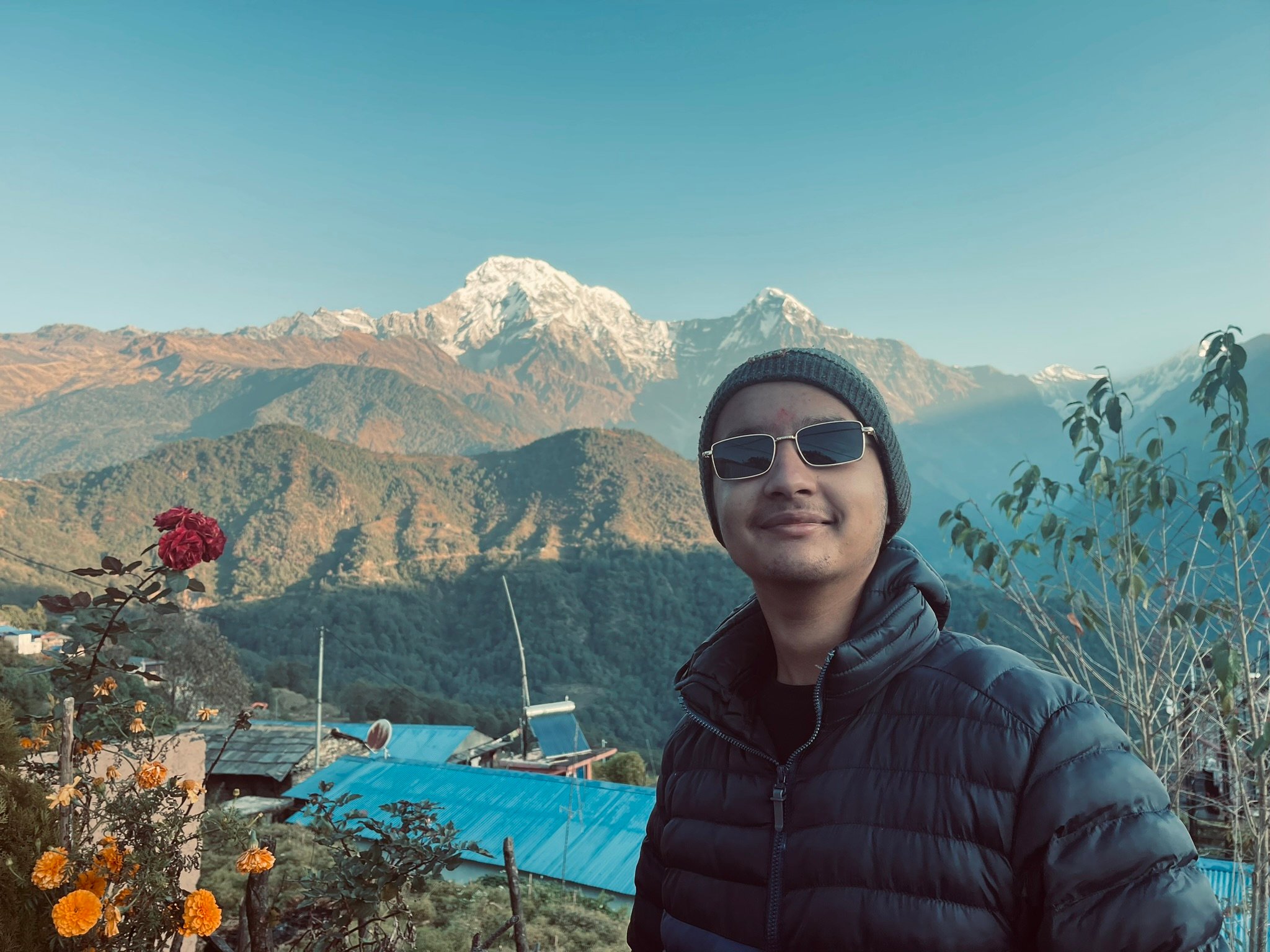

Hi, my name is Shrijan. I'm from the capital city of Nepal, Kathmandu. This fall, I am going to Howard University in Washington, D.C., United States, on a full-ride scholarship! My primary interests are mathematics and computer science, so I’m majoring in Data Science. I love teaching and sharing knowledge, as well as playing sports recreationally.

My Gap Year
Up until high school, I was in the national curriculum. I considered applying to United World Colleges (UWC), but going abroad at that age and stage was something my family and I weren’t ready for. I settled on A-Levels, which turned out to be a great choice. I like how it's research-based and encourages independent exploration.
I applied to colleges during my final year of A-Levels, but it was too hectic. I procrastinated, missed deadlines, and rushed my application at the last minute, which led to an underwhelming outcome. My seniors told me that if you have a clear roadmap for your gap year, you should go for it.
In Nepal, taking a gap year is a bit of a taboo, especially for A-Level students who can technically apply directly. However, studying abroad was a big goal of mine, and I knew I couldn't have managed the process properly without taking time off. Taking a gap year was to give myself another proper shot at applying internationally.
It ended up being completely worth it. I’d initially thought I wanted to do Software Engineering, but I realized what I actually loved was problem-solving and mathematics. I discovered I would enjoy Data Science way more. I did a fair share of travelling—to Australia and around Nepal. I took my first professional job, teaching coding to middle and high-schoolers, which grew my love for sharing knowledge with others.
I completed online courses and did research on quantum-safe cryptography through a summer program, working with a mentor to build a project. I also participated in and organized conferences and hackathons, and helped my high school organize math competitions and designed problem sets for them. A huge chunk of time was also dedicated to the application process itself—I applied to 35 colleges worldwide and wrote around 70 essays!
Applying to 35 Colleges
In my second attempt, I was very deliberate about strategically structuring my college list into reach, target, and safety options. Apart from Howard University, which was one of my targets, I got into the University of Toronto but didn’t receive sufficient scholarship funding. I also applied to a handful of Hong Kong universities and received a full-ride from PolyU and a full-tuition scholarship from HKUST. In the US, I applied to various state colleges and Ivy League schools. This time, I was very deliberate about structuring my college list into reach, target, and safety options.
My advice to students planning to apply worldwide is to tailor your application to what each university looks for and focuses on.
For Hong Kong (HKUST and PolyU), essays need to focus heavily on the exact fit, such as technical achievements: winning competitions and olympiads, your test scores, or projects and research work you’ve done that align with the major you’re applying to, and clear academic reasons for choosing the university’s program specifically.
For the UK, instead of CommonApp, UCAS is used, which only allows you to apply to five universities. Top-tier universities like Oxbridge require the common UCAS essay, which has a character limit of 4k words, to be focused on academic passions. This can be displayed through mentioning extracurriculars related to your major, such as books you’ve explored, online courses, or writing research papers. Non-subject-related extracurriculars like sports or passive volunteering don't matter at all. Admission to top-tier universities also depends heavily on subject entrance tests, which are especially difficult. Since I was applying to a computer science program, I had to take a rigorous math entrance test. Applicants to engineering programs are required to take math and physics entrance tests.
For US colleges, they are more lax about students not having a definitive field of study in mind. They require students to have a strong personal narrative and authentic self-expression. I used a narrative format for my main Common App essay and leveraged the supplements to showcase a multifaceted personality. As for test scores, a higher SAT is critical for achieving top merit scholarships.
Why I Chose Howard
I recommend applicants list five specific reasons for every university they plan on applying to. This will help immensely when it comes to writing your supplementals or answering interviews if you have any.
My five reasons for Howard were:
- The Alternative Spring Break: This program allows students to travel across the US to different cities for volunteer work at no cost.
- AI for Positive Change (AI for PC) Lab: I was particularly interested in their disaster relief chatbot project, which I felt could be applied in Nepal, a country prone to natural disasters. A plus is that they allow freshmen to start working on projects right away.
- Data Science Program: Howard has a dedicated Data Science program, which not many US schools offer. It’s a field that I am interested in because it sits right at the intersection of math and computer science.
- Interdisciplinary Research Building: Howard allows students to apply data science and math to non-STEM fields like economics and business.
- R1 Research Status: As a top-tier research institution, Howard offers strong research opportunities specifically geared toward international students.
Ultimately, I chose Howard because I was awarded a full-ride, which covers tuition, housing, living costs, and stipends. However, applicants should note that most US full rides only cover the academic year, so expenses made in the summer months, such as accommodation and travel, must be managed independently.

Howard Application Process: Essays
Howard had two main supplemental essays: the Community & Diversity Essay and the Why this Major Essay. For the first one, I wrote about my love for walking. My high school was 7 miles away from my house, and despite the distance, I often walked back home to appreciate my surroundings. It provided me a willingness to explore and be adventurous, which later applied to different parts of my life, such as taking on new experiences. I also discussed my motivation for teaching underprivileged students and connected it to my desire to partake in peer tutoring at Howard.
In my second essay, I talked about pivoting from software engineering to mathematics and data science. I highlighted my experience building software, teaching Linux to 100+ people, and winning math competitions. I framed Data Science as the ideal bridge between math and CS to tackle modern issues like the "black box" AI problem and linked it back to the AI for PC lab, one of the activities I looked forward to at Howard.


My Stats & Extracurriculars
For my A-Levels, I took Mathematics, Computer Science, Physics, and Chemistry, and received 4 A*s in the final exam. I scored 150 on my Duolingo English test and 1540 on the SAT. If you apply early to Howard, having an SAT score above 1520 makes you very competitive for their full-ride Presidential Scholarship.
In terms of extracurriculars, one of my major ones was the Uunchai summer program, where I worked with US undergraduate mentors to develop an end-to-end encrypted chat app to protect data against future quantum computing threats and authored a paper on the project. Aside from my service work as a Co-Founder and President of my school’s Computer Club, designer for my school’s media team, and a volunteer Linux instructor, I had a paid job as a Python programming instructor to a cohort of middle-schoolers. I also mentioned winning the national award at the International Youth Math Challenge for achieving the highest score in Nepal.


Borderless was a Lifesaver
I find most college application advice online targets only domestic US students, whereas Borderless tailors guidance to international students navigating non-standard national curricula and backgrounds.
Since I was applying to so many different colleges, I used the Borderless app to keep track of my deadlines, requirements, and categories: reach, target, safety. It’s great because the app offers guidance to many colleges around the world. I had more than 70 essays to write, and I don’t know how else I would have kept my applications and essays organized without Borderless. Whether on Google Docs or Excel, it would have been way more difficult to have a clear idea of what my next task is and not procrastinate or get lost in the tabs. I really recommend everyone applying in the upcoming college application season to use Borderless.
Borderless also offers an AI Essay Review. While I think that AI can be flawed in judging overall essay quality and the author’s intended tone, it was excellent at pointing out structure flaws, repetitive sections, and unclear points in my early drafts.
Real Talk For Prospective Applicants
Stop comparing yourself. I know it’s difficult when our application's success seems to rely entirely on how our profile compares to the next applicant, but try to avoid falling down this rabbit hole. At the time of applying, there’s not much you can do about your profile, so my suggestion is to focus entirely on maximizing your resources and enhancing what you already have.
Embrace "Common” Stories. A lot of students, especially those applying to U.S colleges, think they must have an entirely unique life experience to get into college. You don't need a superhero story. There are so many students with similar stories and backgrounds. What matters is your personal perspective and how you frame your real-life experiences.
Be Authentic. The biggest mistake is when you do impressive-looking activities for college apps that you don’t even enjoy. It’s a waste of time and effort. Don't try to do what you think admissions officers want to see. Authenticity stands out far more than copying activities of successful students.
Don't Put All Eggs in the US Basket. We all know that in this day and age, U.S. admissions can be unpredictable. For many international students, the student visa process has gotten harder, and many countries have citizens completely barred from even getting a travel visa. Make sure you have alternative options. Hong Kong, Canada, and Europe offer top-tier education, generous scholarships, and more stable pathways, making it advisable to also apply to universities in these countries, not just in the U.S.
Best of luck!