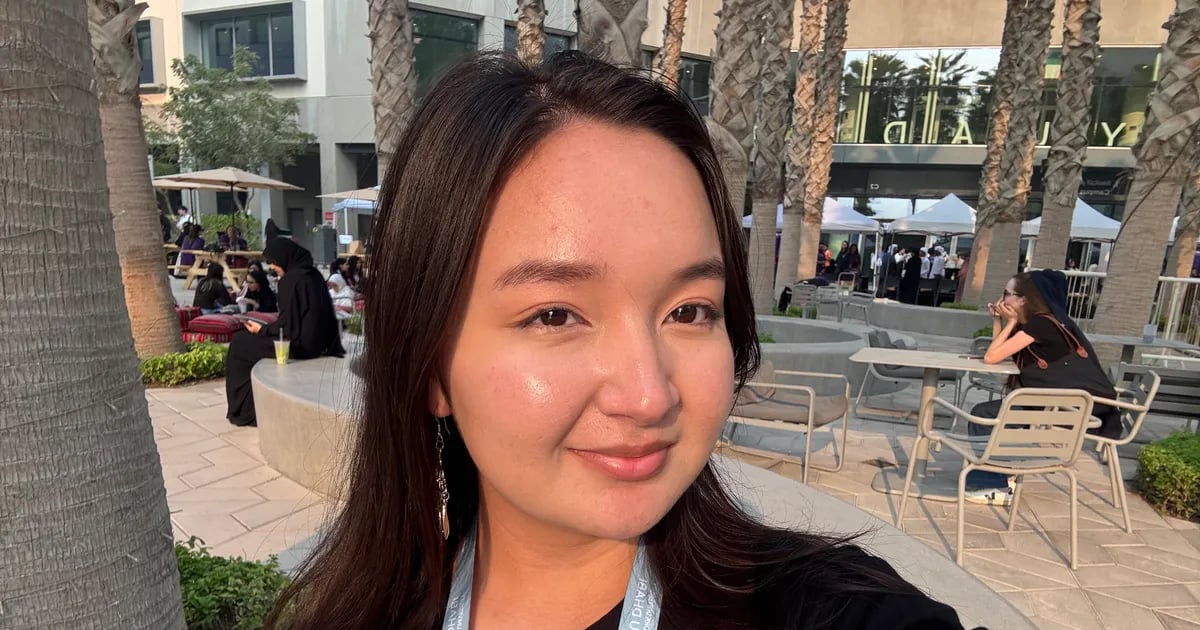

My name is Aruzhan Yerkebulankyzy, and I’m from Öskemen, Kazakhstan. I’m currently a senior at Nazarbayev Intellectual School in Öskemen, and I will be starting my undergraduate studies at NYU Abu Dhabi this fall, where I intend to explore Mechanical Engineering. For a long time, I believed highly selective college admissions belonged to a certain kind of student — the “perfect applicant,” someone with Olympiad medals, prestigious summer programs, years of research, and a carefully built profile. My own path did not look like that. Looking back, I think it was precisely that unconventionality that made my application stronger.

Why I Wanted to Study Abroad?
Studying abroad had been part of how I imagined my future long before the application process began. It started with curiosity: first through learning English as a child, then through becoming interested in other languages and ways of thinking. At one point, I even imagined studying in Korea because I had become fascinated with Korean language and culture. Over time, however, this aspiration grew beyond any one country and became a broader desire to experience different cultures.
Being at NIS reinforced that vision. From seventh grade onward, I watched upperclassmen go to universities in Hong Kong, Korea, China, and later increasingly to highly selective Ivy League. That made studying abroad feel more tangible for me. What attracted me was not only educational opportunity, but also the possibility of being in spaces where people from different backgrounds think together and learn from one another.
Why NYU Abu Dhabi?
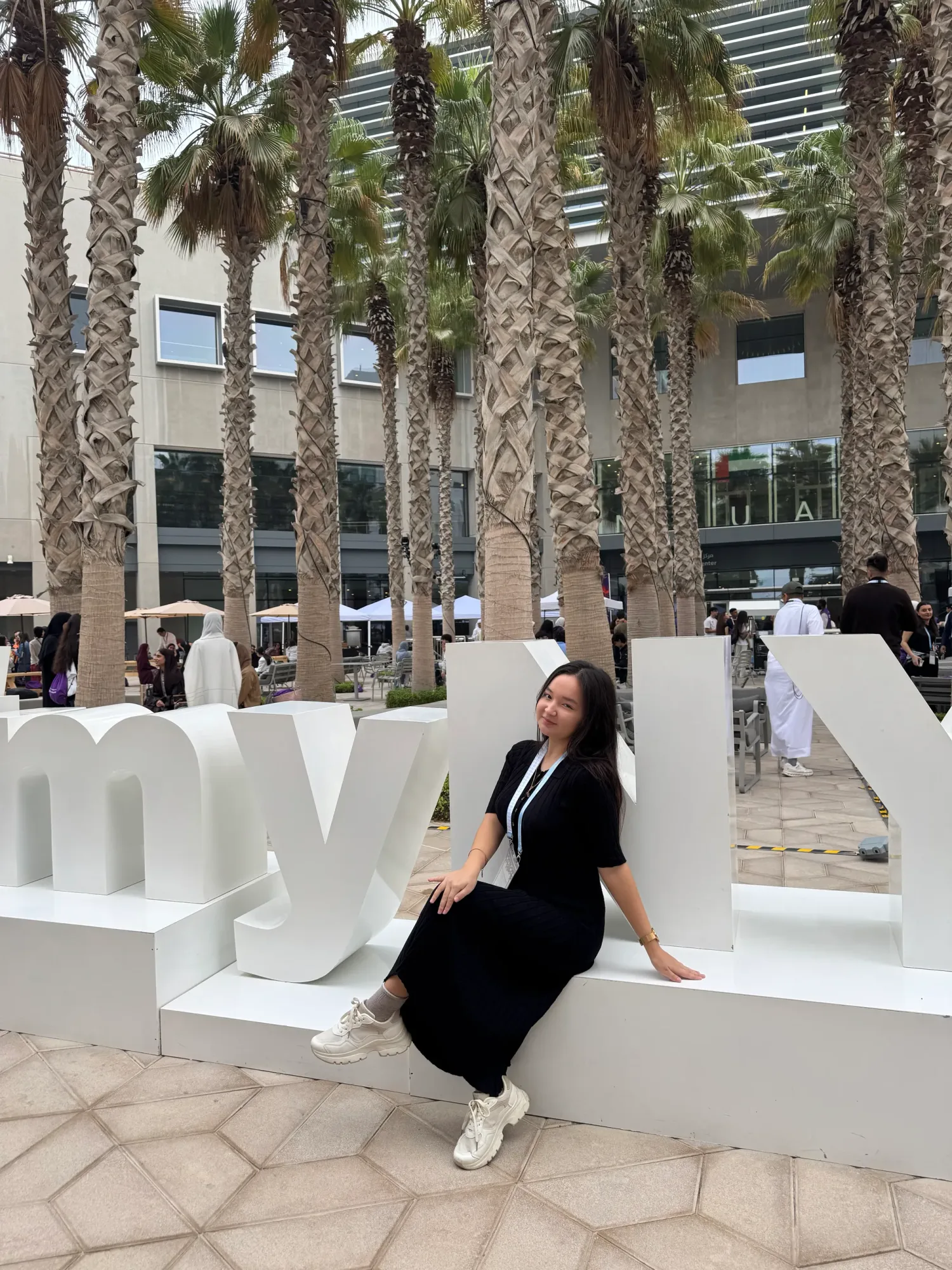
NYU Abu Dhabi became my first choice after an information session I attended in 10th grade. Initially, it was simply another university presentation I joined while exploring options, but the more I listened, the more I felt the university was structurally different from others I had researched. The global NYU network and the opportunity to study across campuses immediately stood out, but even more important to me was the composition of the student body and the philosophy behind the institution.
During my FLEX exchange year in the United States, I became much more aware of what it means to navigate cultural differences. That experience made me realize how much I valued a university where intercultural learning was embedded into everyday life.
Financial aid was also a major factor. As an international student needing substantial support, I had to think strategically about where academic fit and financial possibility aligned. NYU Abu Dhabi stood out because it offered both. The study-away model, strong engineering opportunities, and generous aid made it both an aspirational and realistic option.
Academic Profile & Standardized Testing
Regarding my academics, I have a 5.0 GPA at school. I earned a 1560 on the SAT, with 800 in Math and 760 in Verbal, and scored 8.5 on IELTS. At one point, I thought those numbers would define everything about my candidacy. Like many applicants, I internalized the idea that crossing certain score thresholds was what made someone competitive.
Over time, I came to see those metrics differently. They mattered, but they were not the center of my application. Particularly for places like NYU Abu Dhabi, I increasingly felt that statistics function more as a baseline than a compelling story. Strong scores may help open the file, but they do not make an admissions officer remember you.
One thing I often emphasize to applicants now is that scores should support a story, not replace it. I think students sometimes overestimate how much admissions is about quantitative comparison and underestimate how much it is about coherence.
An Unusually Chaotic Application Process
Ironically, despite how polished admissions outcomes often look in retrospect, my application process itself was surprisingly chaotic. I nearly did not apply Early Decision at all. At the beginning of senior year, I was overwhelmed, uncertain, and not convinced if I was ready. I had not finalized a college list, did not have a finished personal statement, and had no carefully organized application system.
It was only about two weeks before the November 1 deadline that I decided to apply. That meant building almost everything in a compressed sprint. I did not have elaborate spreadsheets or expensive consulting support. I relied mostly on free online resources, conversations with friends, and improvisation.
Oddly, that urgency created clarity. With no time to endlessly optimize an image of myself, I had to answer a simpler question: who am I actually trying to present? That question ended up shaping the entire application much better than any strategy document could have.
Looking back, I would still advise applicants to start far earlier than I did. But I also learned that authenticity sometimes emerges when there is no time left to perform.
Personal Statement & Essay Approach
My personal statement centered on Formula One, which surprises people until I explain that motorsport was never just a hobby to me. It had long been a framework through which I thought about systems, precision, and adaptation. The essay used engineering metaphors to explore the way I approach problems.
One metaphor I returned to was redesign. I described journaling as my “CAD software,” a place where I was redesigning parts of myself during my exchange year. That idea emerged from a realization that in environments where conformity had once been rewarded, I had learned how to fit in, while in a different environment I had to learn how to become more fully myself.
The final essay became a montage structured around three scenes: a childhood memory in my grandfather’s garage where my fascination with cars began, a conflict during my exchange year framed through engineering metaphors, and an example of applying systems thinking to solve team problems. The essay stood out not because of Formula One itself, but because it revealed how I think.
That became one of the biggest lessons I learned about essays: a personal statement should not simply narrate experiences; it should reveal your vision.


Building an Unconventional Profile
One of my biggest insecurities was that my extracurricular profile did not resemble what people often frame online as “elite.” I did not have international Olympiad medals, nor did I attend many of the famous summer programs that often dominate applicants’ resumes. For a long time, I interpreted that as deficiency.
Over time, I began seeing that my activities had a different kind of coherence. On my Common Application, I filled all ten activity slots, and some of the most significant included founding Formula NIS, interning in mechanical engineering and clean energy, helping lead Quantum Project’s international STEM hackathons, and my FLEX exchange year.
They were all connected by intellectual and personal continuity. Even founding the Formula One club mattered not because it sounded unusual, but because it grew organically from a passion that also shaped my essays and academic interests. I think admissions officers can often feel the difference between constructed spikes and genuine interests.
That realization changed how I thought about extracurriculars entirely. I stopped asking whether my activities looked impressive enough and started asking whether they made sense together.

Content Creation, Identity, and Altyn Mind
Another part of my journey that shaped my application, even if less formally, was content creation. Through my platform Altyn Mind, I initially began sharing language-learning advice and exchange reflections, but over time it evolved into a much broader space for writing and thinking about identity, ambition, loneliness, and education.
A belief that increasingly shaped that work was that students are too often reduced to metrics. Your IELTS score is not your personality. Your SAT score is not your identity. Even the university you attend should not become the totality of who you are.
That perspective deeply shaped how I approached admissions as well. Ironically, what many might consider extracurricular “side projects” often reflected some of my deepest values and perspectives. And I think those personal perspectives matter in admissions much more than students often realize.
If I Could Do Something Differently
If I could go back to the beginning of high school, I would probably plan more intentionally. I would explore opportunities earlier, take certain academic competitions more seriously, and research colleges sooner. From a purely strategic standpoint, I can imagine building a stronger conventional application.
But philosophically, I would not change much. My journey was messy, improvised, and often unplanned. Yet that unpredictability shaped me in ways a perfectly optimized path might not have.And I do not think I would trade that for anything.

Advice for Applicants
If I had to offer honest advice to students applying, especially those who feel they do not fit the “perfect applicant” mold, it would be this: do not confuse unconventionality with weakness.
Build depth in something genuinely yours. Create your own projects rather than only participate. Do not chase activities simply because they sound impressive. And stop assuming every polished applicant online has discovered some secret formula you are missing. Often they have simply packaged their story well.
Especially for NYU Abu Dhabi, I would add that being different can be an asset. Not every institution rewards divergence, but some do.
For a long time, I thought my application was too scattered and too unlike what selective admissions were supposed to reward. The parts I worried about most — the nonlinear path, the niche passions, the lack of conventional credentials — became some of the strongest parts of my story. And maybe that is what I would want other applicants to take away.
You do not have to become a “perfect applicant.” Sometimes the more powerful task is understanding what makes your imperfect path distinctly your own.