
Hi, I am Wai Yan! I am a member of the Class of ’28 at Dartmouth College, pursuing a bachelor’s in Electrical Engineering. In this article, I will share my college application process, my experience at Dartmouth, and advice to all international students applying to college this application season.

My Background
I was born and raised in Yangon, Myanmar, where I attended Thalun International School. I did AP courses and the SAT in Myanmar with the intention of applying to US colleges in 2024, a year before the travel ban that greatly affected Burmese students. Right now, I think it makes more sense for them to do the IB or the A-levels. At this high school, my GPA was around 4.0, and my SAT score was 1540 (790 Math, 750 English). Standardized tests are definitely an advantage if you are aiming for a prestigious university. I recommend taking them multiple times because it’s rare that your first attempt will be your best score. Most students’ scores always get higher with each attempt. It’s a lot of effort, but it’s worth it to keep trying.
Essays, ECs & Financial Aid
When I started applying, I mainly targeted universities that gave good financial aid. Every US college publishes the Common Data Set (CDS), where you can look at the average amount of aid they give to international students. I applied Early Decision (ED) to Dartmouth because of its generous financial aid. Although I received a full-ride offer, living expenses are approximately $25,000 per year. Through stipends earned from on-campus work and research, I earn about $17,000, bringing the net total cost to around $10,000. Of course, there were other schools, such as Harvard, Yale, Princeton, and MIT, that offered generous financial aid, but I thought they would be too competitive.
My essays mainly centered around my motivation for studying engineering. I talked about how I have witnessed and experienced energy challenges, such as limited electricity in Myanmar, and how this major will help me build real solutions to these problems one day. As for extracurricular activities, I was involved in mostly leadership and community service at my school for about seven years. I was President of the Thalun Community Service Club, tutored for the SAT, and worked as an Editor for my school newspaper. In the last two years of high school, I was the Secretary and later, the President of the Student Council. Because I was genuinely interested in leadership and service, I dedicated a lot of time and effort throughout school.

More on Extracurricular Activities
My advice for students currently in high school is not necessarily to do the most impressive, prestigious, or widely recognized extracurriculars, but to find a set of interests and hobbies that truly appeal. The prestige comes second to developing values, interests, or beliefs from those experiences. For some people, it could be music, arts, sports, or building things. For others, it could be STEM, sharing knowledge, or research. Even if you don’t know exactly what field you’re going to major in, it’s important to find something that resonates personally and stick with it long-term.
Results don't come immediately. It takes years and years for it to sound impressive on a college application. My leadership positions in my ECs only came about after more than four years of consistent commitment. I think it’s very important to find something that you're passionate about, and really use that as a chance to learn, grow, and develop.



The Value of Soft Skills
I see a lot of students concerned about what they want to study in college, or whether what they did in high school is relevant. Most US colleges don't lock students into majors based on high school preparation. As for relevance, in my major, I know many friends who took linear algebra in high school and have done complex engineering projects. My background was mostly in leadership and community service, so I felt like there was a gap in skills. If you have prior knowledge coming into a subject, you may feel less stressed during the first few months when you’re still adjusting to a new environment. However, this advantage only lasts for a semester, and everyone starts learning new material together. It’s okay if you feel underprepared for your major compared to your peers.
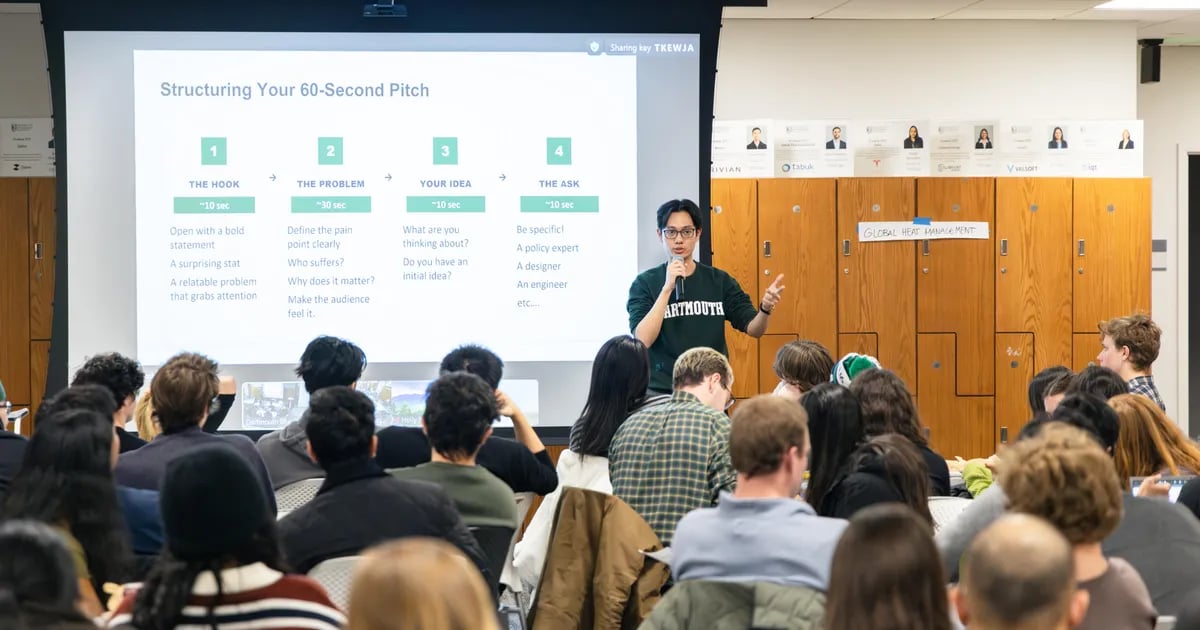
I'm not sure if you know how to code in Python or solve first-order linear difference equations. But that doesn't really matter because you can learn in a couple of months during your first year. What matters more are your personal traits: problem-solving, leadership, resilience, and innovation. These skills are far more valuable long-term than the specific technical knowledge you learn in college. And you gain these soft skills through your extracurriculars. This is why I really want to emphasize learning how to network, communicate, and pitch projects.
The Dartmouth Experience and College Life
Something really exceptional at Dartmouth is its liberal arts curriculum and focus on interdisciplinary learning. Although I'm an engineering major, I've taken humanities, writing, and music courses because they are required. Each course is very different from what engineering is in principle, but they teach you to become a well-rounded person.

College is the best time to meet people. You’re all experiencing a period of your life where there’s a lot of change happening, you're learning a lot of new things, and everyone else is at the same point in their lives. It’s important to use your time here to make as many friends and connections as you can—not just to grow your LinkedIn connections, but to meet people that inspire you, interest you, or people you enjoy spending time with. Also, life is not always about the grind. To prevent burnout, practice self-care by going to the gym, doing outdoor activities, getting adequate sleep, and spending time with friends or alone as needed.
Last Piece of Advice
While I was applying to colleges around the world at the end of high school, I didn't know much about my future. I had a lot of anxiety due to this uncertainty, and whenever I got rejected from an opportunity, it would feel really bad. But sometimes it's the moments of failure, rejection, or uncertainty when you learn and grow the most.
Right now, I'm applying for internships, and I've been having a terrible time, getting rejected by so many programs. But I know that in the long run, this will be a learning experience for me to work on what I need to improve. You're allowed to feel frustrated or sad, of course, but also take that as an opportunity to learn, reflect, and really grow.