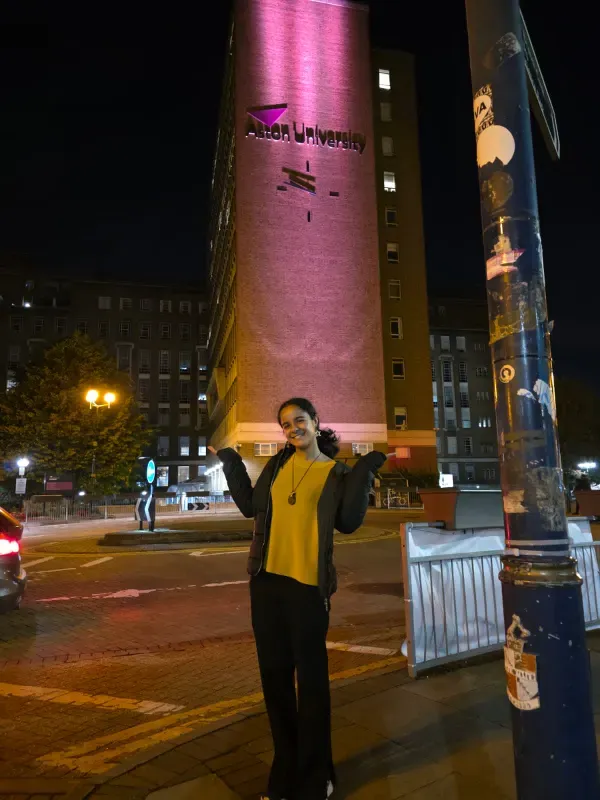
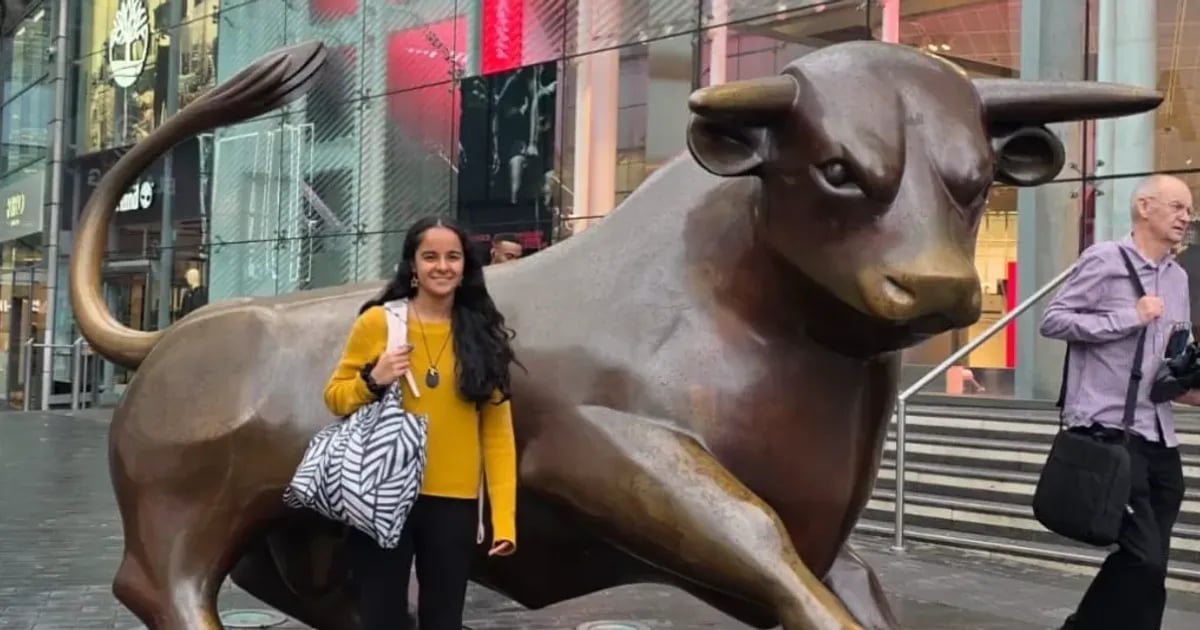
Meet Nicole! If her personality was a type of weather, it would be a bit cloudy with a rainbow. She irrationally loves saying the word ‘centrifuge’ out loud, and she unabashedly admits that the first thing she would do if time froze for 24 hours would be to raid everyone’s fridges for ice-cream. She believes that the most ruinous snack one could bring to a serious meeting would be the mystery flavored jelly beans that were popular in her childhood! She would love to forever bottle up the feeling of wonder that she first experienced when she got to Aston. The huge buildings, gorgeous flowers, trees strung with fairy lights, the vibrant student union, new and exhilarating on-campus events, diversity and the faith center; she loves it all! She reflects that with time, these things will probably fade into the background of her everyday environment, but she secretly hopes that they will always enchant her just the same.
- Journalist’s note <3
Background
Hello! My name is Nicole Menezes, I am 18 years old and I'm from India. I relocated a lot when I was younger, so I haven't really lived in my home country much. I’ve had quite a lot of changes in scenery, having lived in Jordan, Kuwait, Cameroon, South Africa, and Kenya! I completed my secondary education in Braeside Lavington High School in Nairobi, Kenya, where I’ve lived for the longest period of time.

UK: Biomedical sciences development
I chose the UK because of my interest in biomedical sciences. I strongly felt that the prospects of a future in this field would be very limited in Kenya. If I did manage to acquire placement here, the projected salary is incomparable to one I'd earn in a developed country. Most importantly, my passion in Biomedical sciences draws me to a future in Research and Development (R&D), which does not attract sufficient government investment here, in comparison to developed countries. These drawbacks, along with inaccessibility to advanced modern laboratory apparatus and lower ranked facilities, led my study destination aspirations to gravitate towards going abroad. I decided to study abroad to secure opportunities for both now, whilst finishing my higher education, and after!
There were several reasons why the UK seemed to be the most suitable choice, however I was undeniably influenced by the application process. The UK’s application and tuition deposit (to secure admission) deadlines were much earlier than most other countries that I shortlisted, which pressured me to look into the UK as my primary option. Additionally, as I continued to research UK universities and attended university fairs, I came to appreciate numerous benefits of studying in the UK. For instance, the time difference between Kenya and the UK is fairly small, which means that communication with family and friends would be convenient for both parties. Plus, unlike the US or Australia, it isn't on the other side of the world! This also meant that the flight time would be substantially less unbearable for holiday visits. Due to the nature of my course, my high school career counsellor (who helped me navigate my university applications) advised me to centralize my research in the UK and US where opportunities in R&D are plentiful and lucrative. All these aspects placed the UK in a really favorable light, and that's why I settled on it!
Why Aston University?
I chose Aston University in Birmingham as my firm choice, or rather my first choice, because I felt it had the perfect range of everything I was looking for. Tuition fees are significantly less than the Russell groups’; its prestige is much greater than several mid-range universities and was well known by my career counsellor. It is well ranked, impressively accredited, and had amazing value in scholarships, which was one of the most important factors for me! Although the idea of attending a Russell group university was very appealing at first, I realized Aston had everything I needed, maybe even more. I may consider a Russell group for my post-graduate studies, but for now Aston was the perfect match. Aston’s location in Birmingham was a huge comfort to me; I wasn’t too keen on studying in a big city, worrying about personal safety and higher costs of living. Birmingham is home to 4 other universities, making it a vibrant, youth-filled area! At Aston, I don’t feel too far from the heart of the city either, as London is just about an hour away on the express train line. In total, I applied to 6 universities in the UK. Aston University of course, as well as York St. Johns University, University of Sunderland, Nottingham Trent, Ulster, and University of Southampton. I got acceptance offers back from all of them! My final decision was influenced by affordability and quality, and thus, I started my university journey in September at Aston!
Stats
At the time of my application, I was yet to sit for my A-level exams, so I applied with my predicted grades, which is the standard procedure when it comes to applying to the UK. My predicted grades were (AAAA), an A in biology, and A stars in math, chemistry, and physics. It admittedly does put a level of stress on you, because I was accepted based on these grades. So even as I prepared and studied for my finals, that standard was very impressionable in what I would think about. The grade requirements for Biomedical sciences in Aston were a BBB, so I definitely wasn't in danger of being locked out of the course if I slightly underperformed. However, the key to the best scholarship opportunities was how good your submitted predicted grades, and final transcript, was. For my final grades, I got an (AAAA), in math, chemistry, biology, and physics respectively, which I am extremely blessed for. Thus, I was able to secure my preferred placement and a scholarship!
Extracurriculars, honors, awards, and community service
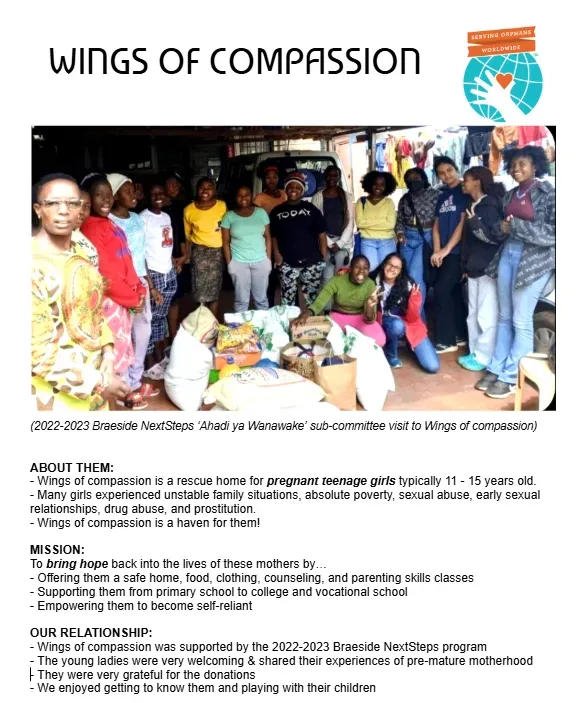
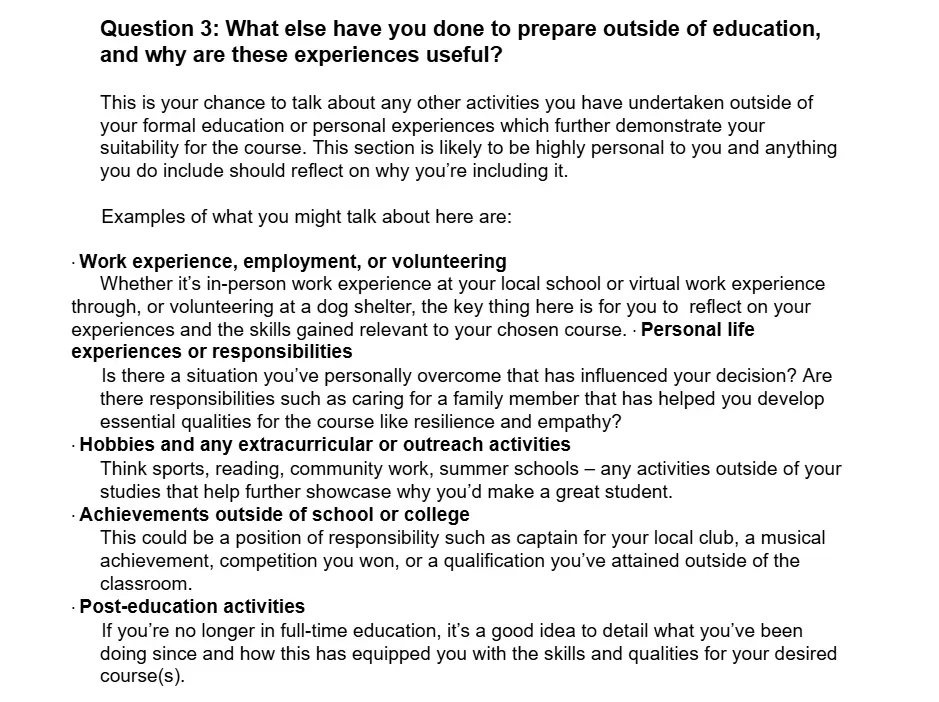
First of all, I’d like to debunk the myths and misconceptions about extracurriculars when it comes to university applications. You don't get a chance to list all the extracurriculars you've done over the years of high school, therefore, it isn't really the case that the more extracurriculars you do the better the standing you have! I incorporated a select number of extracurriculars, community service and awards in my personal statement. Of all of these, volunteer work was the most impactful thing for me to mention, as it was imperative that I could demonstrate how I've given back to the community before, and my intention to continue to do the same after my course, and impact communities with the research I carry out at Aston. I mentioned my volunteer experience at Kenya Society for the Protection & Care of Animals (KSPCA) that I did over the summer holidays after my IGCSEs, with friends. Originally, it was an idea that had been proposed in school, for all students in my year group to do, however there was very little interest and initiative. Therefore, my friends and I decided to do it alone, and it was a memorable and lovely experience. Similarly, my friends and I led an initiative to support a rescue home for teenage girls who are vulnerable. Named ‘Wings of Compassion’, we briefly got to know them, and were able to donate a variety of things to the girls.
Moreover, I outlined 2 work experience placements that I had, this included two internships with Gertrude's Children's Hospital, and a memorable school visit to the Kenya Bureau of Standards (KEBS). I demonstrated the latter’s relevance by drawing the similarities between what they did, and what I would like to do (i.e testing of products such as detergents)! I outlined quite a number of my extracurricular activities, briefly explaining my participation or achievements in each, and how they equipped me with essential soft skills. My sports journey nourished my collaboration and interdependence skills, as did World scholars. I mentioned the Buddy system, a student counselling program that I participated in at school, because it’s important to be able to mentor your peers in the workplace as well. My leadership role in the school’s student council, and its impact on my character, the Rotary Interact Club where I gave back to the community, Battle of the Crows Colloquium, a competition that pushed my limits in public speaking. Finally, I talked about a first aid course that I had undertaken in school, and a performing arts experience in my former school. This may sound like a huge lump of random activities, but I found that the best way to interconnect them and make them relevant is to bring them up in relation to the development of your personal growth, or contributions to your passion about your desired field of study!


The origin spark! My passion for biomedical sciences
I have a distinct memory from middle school, where my biology class was going through a text about tomatoes that had been genetically modified to give you more protein. Due to this they were stronger than the average tomato, and extraordinarily pest resistant as well. We went on to read about a type of fish which had been injected with a certain gene that would make them fluorescent in polluted waters, that later became instrumental in helping people in maintaining pollution water levels, because there was a clear indicator of when it was at a hazardous level! My heart was immensely captivated by these instances, the idea that we could modify nature to suit human needs. In some cases, it could pose a danger if in the wrong hands, but to me it was simply inspiring! I thought about it further, and considered the fact that a pretty prevalent problem that we have back home, in India, is malnutrition and poverty; but when you look deeper into the issue, you would realize that there is easily enough food for everyone. The distribution and decreasing nutritional value is the real issue. If a solution could be developed for it, I strongly believe that the biomedical field could have a role to play in it! The breakout of the Coronavirus pandemic, and watching all the front-liners and researchers working hard to develop a vaccine was another inspiring spark for me. I could imagine myself doing research to help develop vaccines, and impacting and helping so many people whilst doing that. I fell in love with the Bsc degree, not only because of these experiences, but because of its potential to make an impact in societies today!
Application process via UCAS
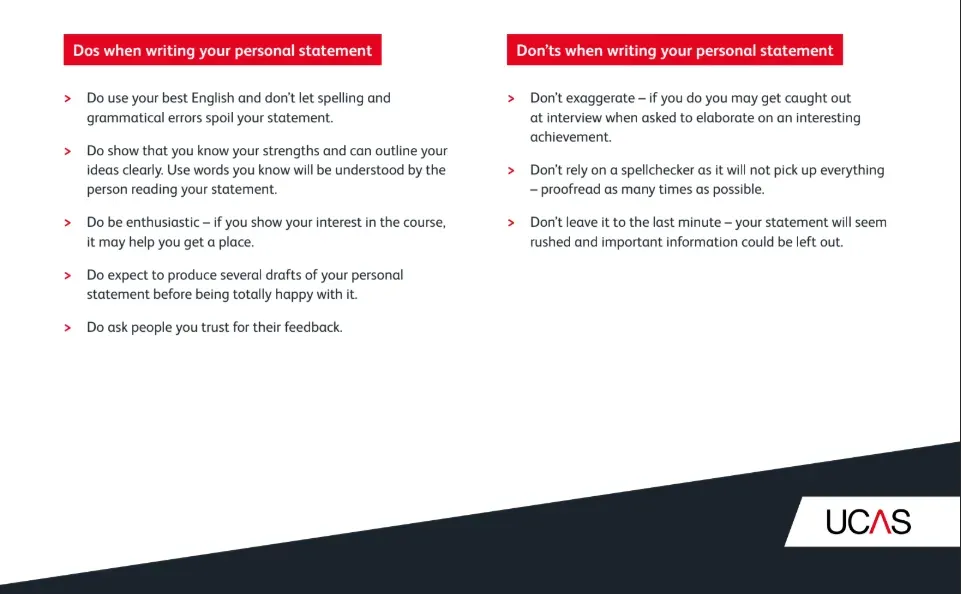
I applied to all my universities through UCAS, which means that I was only required to write one application essay, my personal statement. The format tends to vary, but I used a structure outline that my school prepared for us! The structure is slightly more compiled now, but when I was applying, each paragraph had a specific purpose. As is to be expected, the first paragraph was where I had to explain what I planned on doing with the course, as well as give a brief introduction of what inspired me to pursue biomedical sciences, and my passion for it. The second paragraph was all about achievements! This is where I talked about my subject choices and my grades, my awards, and any extracurriculars that I had done that could be relevant. In the next paragraph I outlined my work experience and a few more extracurricular activities. After that I talked about my leadership journey, my personal values, and how the extracurriculars I did shaped me to become who I am today. My final paragraph was my reasoning for choosing the UK, and why I thought I would be a good fit for the university I was applying to. Unfortunately, because the UCAS system operates by sending your personal statement to all the Universities you choose to apply to on the portal, I had to be pretty vague for the last question. All in all, the application process was fairly simple, other than writing the personal statement. Other than that, the application procedure included having our career counsellor upload our predicted grades onto UCAS, handing in our identification document copies, and then you're done! I started preparing my applications about a month before the deadline, which should be enough time to review, go through, and polish your application until you are satisfied with it.
Mentorship: Treasure your support systems!
Throughout my application journey I was heavily supported by the guidance and career counsellors at my school. All throughout year 12 and 13 they would encourage us to start writing our personal statements, to start doing our own research and to come up with university lists. We were given an outline structure to follow for our personal statements too! At the time, it felt more annoying than encouraging, because I would feel like incredibly stressed and overwhelmed by the amount of pressure they were putting on us. In hindsight, I’m definitely more grateful for it now, for they set the stage for a smooth application experience.
We also had the privilege of having one-on-one meetings with the career counselor, and we did a lot of peer evaluation exercises too; exchanging personal statements with our peers and reviewing them for each other, then going through them with our parents. Honestly speaking, I don’t think I would have managed to get the process down as smoothly if it hadn’t been for all these people by my side, supporting me and cheering me on. They curbed a considerable amount of my confusion and stress about the application processes. For instance, at first I was pretty confused because of all the different deadlines for different regions in the world, so it was such a blessing to have people reminding us which deadline came first, and just generally overseeing the entire process!
Tuition Fees and Scholarships
Tuition fees are £21,500 per year. I was awarded a one-off scholarship of £10,000 that was applied to my first year.
Advice to future applicants
- I’m not exactly sure where I got the impression that it would, but something that really surprised me about UCAS was that it does not help you pick your universities. The portal does not give any rankings or suggestions when it comes to filtering through all the options. The research is purely on you; therefore talk to your peers, your parents, and your career counsellor, and be intentional about where you apply to!
- Once again, be intentional about where you choose to apply to, and research widely before you make your decisions. Personally, I barely gave any consideration to universities outside of the UK, because of the admission timeline differences. Consider the differences in deadlines from region to region, it’s not something you want to overlook.
- For those applying to the UK, you may want to adopt a proactive strategy when applying for your visa. If you can manage to, the earlier the better. Our A-level results came out in the second week of August, and the semester starts a month later. Generally, most visas, if not all, are issued on the basis of unconditional offers, and it is only after you submit your grades after receiving them, that the offer becomes unconditional. This definitely isn’t the case everywhere, but I’ve heard of instances with some of my friends’ siblings, who were forced to miss the first 2 weeks of school because their visas came out late. I don’t necessarily have a solid piece of advice to prevent this, but it’s definitely an outcome to be aware of, and proactive to prevent!
- This is something that I don’t believe is discussed as openly as it should be, when it comes to the admissions process, if you accept an offer, especially a conditional offer, most universities in the UK will ask you to pay a deposit to secure it. It’s a non-refundable deposit that is requested for a number of months before the start of your enrollment, mine was approximately a quarter of my tuition fees. This is key especially if your offer included a scholarship as well, you must pay the deposit to confirm both your acceptance of the offer and the scholarship. There was a deadline to pay the deposit by, so I nearly lost my marbles speed running my final evaluation to decide which university’s offer I wanted to accept, all while juggling accommodation booking, and studying for my final papers!
- My final piece of advice is an unpopular take, but I believe that it should be taken into consideration that these are only your undergraduate studies. Even If you don’t have the privilege to, or if you are unable to go a prestigious university, the highest ranked universities, or even your dream school, you will be okay! Presumably, most of us are going to pursue post-graduate studies as well, so in hindsight, I strongly believe the stress that we associate with undergrad is not entirely justified. I’m not advocating for international students to not care about their undergraduate applications, all I’m saying is, it would be prudent to think beyond your first four years of University. Essentially, most employers will be more interested in your post-graduate degree than your undergraduate degree, so think about that too!
Future plans
Beyond working, internships or immediately diving back into studying, I haven’t given much thought to what I’d like to do after graduation. I hope to get the privilege to have a sandwich year ( a year of paid internships or work in between your duration of studies), then go straight for my post-graduate studies after graduation!