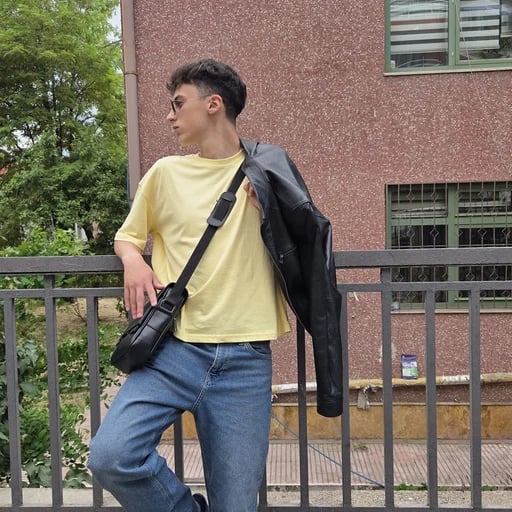
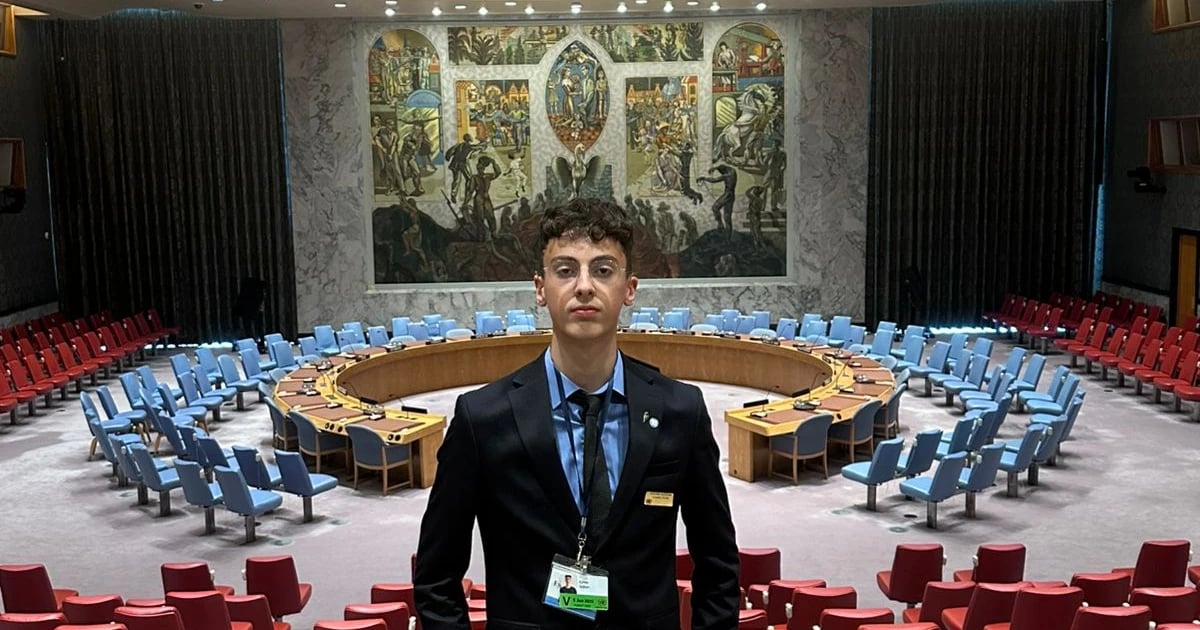

Hi! I’m Eymen, a Turkish student who will be spending the next four years at the University of Alberta.
As someone who has always wanted to explore different sides of myself, I never wanted to let the education system in my country reduce me to an academic profile. I have spent the past few years finding ways to break free from the limitations I felt around me. But now, I don’t want to stop at creating a different path for myself. I want to make sure that no young person feels forced into the same academic mold simply because that is what the system expects of them.
I grew up in Sivas, a relatively small city in central Türkiye where opportunities and exposure to international education are much more limited than in the country’s larger metropolitan areas. For many students around me, studying abroad was not a familiar or realistic path. Pursuing opportunities that seemed completely out of reach for someone from my background meant constantly questioning what was possible—and finding ways to make those possibilities real.

An Identity Beyond Grades
For as long as I can remember, I have never been the kind of student who could spend all day studying. It was not because I did not care about my education. I simply wanted more from my life than sitting at a desk and preparing for the next exam. I wanted to play sports, make music, meet people, and be involved in different things. I wanted to become a person with different interests rather than someone whose entire identity was built around academic success.
As I moved through middle school, however, I began to feel that the education system around me was asking me to choose between these parts of myself and my academic life. The message seemed simple: study, study, and study some more. The more I thought about it, the more I felt that following this path would mean missing out on the life I actually wanted to live.
That was one of the first reasons studying abroad began to stay in the back of my mind. I wanted to experience an education system that would allow me to explore different interests while still taking academics seriously. But for a long time, that idea remained just an idea. I thought about studying abroad throughout middle school and ninth grade, yet I did almost nothing to make it happen.
It was not until tenth grade that I finally started asking myself what I actually wanted from my education and, more importantly, from my life. I realized that my frustration with the system went deeper than simply wanting to leave it. I did not want to spend my life complaining about the things I thought were wrong. I wanted to understand them, learn from different systems, and eventually do something about them.
I didn’t simply want to escape the education system. I wanted to eventually change it.
I knew that one person could not transform an entire system on their own. But I also realized that I would rather try to contribute to that change than spend my life wishing things were different. That realization changed the meaning of studying abroad for me. It was no longer simply about leaving Türkiye or getting a degree somewhere else. It became part of a much bigger goal: learning as much as I could, building the skills to make a difference, and eventually bringing what I learned back home.
Building a Path Where There Was None
When I first decided that I wanted to study abroad, I quickly realized that having the ambition was one thing and knowing how to turn it into reality was another. In Sivas, I could not find many people who knew how the international university application process worked. I talked to teachers, reached out to different people, and tried to find someone who could guide me, but there was very little knowledge about the opportunities available to Turkish students abroad.
When I first told people around me that I wanted to attend a university in the United States, many of them did not take me seriously. Some even made fun of me. Studying abroad simply did not seem realistic to them. I remember hearing things like, “I hope you don’t end up with nothing,” even from people close to me. It was difficult to keep believing in a goal when the people around you could not see it the way you did.
The lack of resources also created very practical problems. Sivas did not have testing centers for the SAT or AP exams at the time, so I had to travel to other cities just to take my exams. I also had to prepare for these exams mostly through self-study because there was no one around me who could guide me through the process in detail.
At first, I saw all of this as a disadvantage. I kept thinking about how much easier the process might have been if I had grown up somewhere with more international opportunities, more people who had studied abroad, and more access to guidance. But as I learned more about how American universities evaluate applicants, my perspective started to change.
I realized that coming from a place with fewer opportunities did not necessarily make my application weaker. In some ways, it could make my journey more meaningful. A student from a school with abundant resources and a student from a place where those resources barely exist may have similar achievements on paper, but the circumstances behind those achievements can be completely different.
That was when I understood something important: when opportunities are not readily available, you eventually learn to create them yourself.
I could not create a new testing center overnight. I could not suddenly make everyone around me understand the path I was taking. But I could search for information, contact people, teach myself what I did not know, and keep looking for opportunities beyond what was immediately available to me.
Eventually, I stopped asking myself why I had fewer opportunities than other students. I started asking a different question: What can I build with the opportunities I do have?
That shift in perspective changed the way I approached everything that came next.
Learning to Study Wherever I Was
Looking back, I think the biggest transformation in my academic life happened during my AP self-study journey. Before that, I genuinely did not know how to study.
It is easy to say that I was not a hardworking student in middle school or ninth grade, but that would not fully describe it. I did not even know how to sit down at a desk and study effectively. I had never developed the discipline to organize my time, prepare consistently, or teach myself something from scratch. My ninth grade was mostly about getting good grades on my school exams and moving on.
That changed when I started preparing for AP exams through self-study.
I first encountered AP exams in tenth grade when my advisor suggested that I try them. I only had two or three months to prepare, and I ended up getting a 2 on my first AP exam. At first, I was disappointed, but the experience taught me something important about self-study: when there is no teacher guiding you, it can be surprisingly difficult to know whether you are actually making progress.
The following year, I decided to prepare for four AP exams at the same time. My school day ran from 9 a.m. to 5 p.m., and I was also the captain of our volleyball team, which meant practices and matches often took up my evenings.
There simply were not enough hours in the day.
So I started waking up at 6 a.m. to study before school. I would study until 9, go to school, and then stay at school after classes to study again before volleyball practice. I would pack my dinner in a container in the morning and eat it at school while studying because going home between school and practice would take away too much time.
For a while, I tried to do everything at once. It was exhausting. I was walking around school like a zombie, and eventually one of my teachers noticed. When I explained what I was trying to do, they told me that I could not keep going like that and helped me talk to my other teachers.
Together, we found a solution. I would attend the core classes I needed while using some of the other class periods to study in a glass study room at school. It gave me several extra hours every day without forcing me to sacrifice my education completely.
Even then, my schedule remained intense. I had to keep my school grades high, prepare for AP exams, and lead a volleyball team that had a very demanding schedule. We were constantly traveling to different cities for matches and tournaments, which meant finding time to study wherever I could.
I learned to study everywhere.
I studied on buses while my teammates were preparing for matches. I studied in hotel rooms while everyone else was resting after a game. Sometimes, with only an hour or two before a match, I would be sitting in the back row of the bus with my books open while everyone around me was preparing for the game.
There were moments when I genuinely wondered how I was going to keep up with everything. Looking back, I still do not know exactly how I survived that year.
But somewhere in the middle of all that exhaustion, something changed.
I became someone who knew how to work.
The biggest thing I gained from AP self-study was not the AP scores themselves. It was the discipline I developed while preparing for them. I went from being a student who did not know how to study to someone who could open a book anywhere, find the time, and keep going.
That skill stayed with me long after the exams were over. More than anything else, AP self-study taught me that discipline is not something you either have or do not have. Sometimes, you build it because you have no other choice.
The Sport They Mocked Me For
If there is one activity that represents who I am better than anything else, it is volleyball. For me, volleyball has never been just an extracurricular activity. It has been a community, a family, and one of the biggest influences on the person I have become.
I started playing volleyball when I was in fifth grade. Growing up in Türkiye, however, I quickly became aware of a stereotype: volleyball was seen as a “girls’ sport,” while boys were expected to play football or basketball. My school did not even have a boys’ volleyball team. There was only a girls’ team, so I trained with them throughout middle school.
I was never completely comfortable with the attention that came with playing a sport that people around me did not expect a boy to play. I worried about being judged and labeled, so although I loved volleyball, I never really saw myself as a serious volleyball player.
That changed when I reached eighth grade. The coach who had previously worked at my school had left, so I contacted them because I wanted to keep playing. They helped me join the club team they coached. For the first time, I was part of an actual volleyball team.
That experience changed my understanding of what a team could mean.
My teammates went to different schools and had different backgrounds and experiences from mine. Yet on the court, those differences did not matter. We trained together, struggled together, and experienced both the physical challenges and the excitement of competition together. For the first time, I understood what it meant to truly belong to a team.
When I entered ninth grade, our coach returned to my school. We eventually helped the other players on my team transfer to my school, and I joined the school team with them. They had already been playing together for two years, so I was technically the newcomer to an already-established group.
Yet they welcomed me, and I eventually became their captain.
Looking back, I realize how much my volleyball journey resembles my journey toward studying abroad.
In both cases, I started from a place where people did not necessarily believe in me. In both cases, I entered spaces where other people had already established themselves. I had to adapt, prove myself, and find my place. And in both cases, I eventually found myself taking on a leadership role.
Our team went on to achieve something that had never been achieved by a school volleyball team from Sivas before: we became the first to reach national-level competitions and represent our city at that level. Suddenly, the people who had once made fun of me for playing volleyball were watching our team travel from city to city and represent our school.
The sport that once made me feel different eventually became one of the things that made me most proud.
But the most important thing volleyball gave me was not the trophies or the competitions. It taught me how to lead.
Being a captain taught me that leadership is not about being the loudest person in the room or telling everyone else what to do. It is about understanding the people you are responsible for. It is about listening to their concerns, recognizing their emotions, and creating an environment where they feel comfortable expressing themselves.
I learned that sometimes being a leader means speaking for people who cannot express what they are feeling themselves. It means understanding different perspectives and being able to represent a group even when you are the one standing in front of everyone.
Most importantly, volleyball taught me how to lead without becoming a toxic leader. I learned that a team cannot be held together through fear or pressure. People perform better when they know that they are understood, valued, and heard.
The leadership skills I developed through volleyball stayed with me long after I left the court. They became part of how I approached other communities, projects, and responsibilities throughout high school.
Volleyball also gave me a confidence and versatility that I could not have developed in a classroom alone. It taught me how to communicate with people who were different from me, how to adapt when things did not go according to plan, and how to keep moving forward when I felt like an outsider.
For years, I thought volleyball was simply something I loved doing after school. Now I realize that it was also teaching me how to become the person I wanted to be.
Research as a Way Into the Real World
When I first started exploring international relations, I struggled with one question: What can I actually do in a field like this while I am still in high school?
If you are interested in STEM, there are laboratories, experiments, and tangible projects you can work on. But in social sciences and humanities, the opportunities can look much less obvious. My advisor once told me that, in these fields, research could be one of the most meaningful ways to start exploring the academic side of what I was interested in.
That was how I first heard about the Lumiere Research Scholar Program.
I applied during the spring after my tenth grade. At that point, my resume was almost empty. I had only recently started taking my international education journey seriously, and I did not have years of research experience or a long list of extracurricular achievements to show.
In fact, one of the strongest academic results I had at that point was a 2 on my first AP Comparative Government and Politics exam.
Still, I was accepted into Lumiere with a scholarship.
Looking back, I think this experience taught me something important about applications: sometimes, what you have done matters less than how well you can explain why you are doing it.
In my application, I tried to go beyond simply saying that I wanted to study international relations. I talked about why I cared about education, why I wanted to contribute to my country, and why my frustration with the education system had turned into a desire to help change it.
That motivation became the foundation of my research experience.
I joined the summer cohort, which lasted for three months, and was matched with a mentor who was an Oxford professor. I was nervous at first. I had imagined that working with someone from Oxford would be extremely intimidating, but my mentor was incredibly supportive.
During the first few weeks, I spent most of my time reading. My mentor sent me academic papers and materials about current international security issues, including topics that were being discussed at the United Nations at the time. They were also working with the United Nations Security Council during my research, so many of the issues we discussed were connected to real conversations taking place at the UN.
For the first time, I began to understand what it meant to go beyond simply learning about a subject and actually investigate it.
My research focused on the Russia-Ukraine war and the legal challenges surrounding the classification of Russian soldiers accused of killing civilians as war criminals. The topic was also closely connected to my mentor’s own academic work, which made our discussions even more meaningful.
But the most unexpected part of the experience happened outside the research itself.
Toward the end of my research, I travelled to Ankara, the capital of Türkiye, for an internship at TED University. While I was there, I also visited the university’s rector, who had previously helped me find the internship.
During our conversation, they asked me what I had been working on. I told them about my research and explained my topic.
Then they said something I never expected to hear:
The Ukrainian Ambassador was a close friend of theirs, and they could arrange a meeting for me.
I immediately contacted my Lumiere mentor and told them about the opportunity. Soon afterward, I had an online interview with the Ukrainian Ambassador.
I was able to include the interview in my research paper, and we even added a section discussing possible solutions based on our conversation.
That moment completely changed the way I looked at research.
I had started Lumiere because I wanted to find something tangible I could do as a high school student interested in international relations. I never expected that writing a research paper could eventually lead me to speaking directly with a country’s ambassador.
Research was no longer just something I was doing for an academic program. It had become a way for me to connect my interests with the real world.
And that is what made the experience so valuable to me: it showed me that even when opportunities are not immediately visible, creating something meaningful can become an opportunity in itself.
Becoming the Person I Once Needed
For a long time, I thought I was alone in my struggle to find a path toward studying abroad.
Living in Sivas, I had spent years trying to find people who could guide me. I knew what I wanted, but I often did not know how to get there. There were not many people around me who had gone through the process themselves, and that sometimes made the journey feel very isolating.
That changed when I was accepted into the Yale International Relations Leadership Institute, or YIRLI.
By the time I applied, my resume was much stronger than it had been when I applied to Lumiere. I had built up research experience, leadership roles, and extracurricular activities. But I still believe that the way I presented myself mattered just as much as what I had done. After all, the application already asks for your resume. The purpose of the questions is not to hear your resume all over again, but to understand the person behind it—to see your ideals, your values, and what motivates you.
When I arrived at YIRLI, I expected to learn about international relations. I did not expect the program to change the way I saw my own story.
Every morning, Yale professors gave us academic seminars, and we had the opportunity to listen to incredibly inspiring speakers. Our mentors were also incredibly supportive, and the students around me were open, social, and genuinely interested in one another.
But what affected me most was realizing that I was not alone.
Until then, I had thought of my experience in Sivas as something very specific to me. I had struggled to find guidance, opportunities, and people who understood what I was trying to achieve. At YIRLI, I met students from different parts of the world who were facing remarkably similar challenges.
We came from different countries and backgrounds, but many of us shared the same frustration: we wanted to pursue opportunities beyond what was available around us, yet we did not always know where to start.
For the first time, I realized that what I had experienced was not just a “Sivas problem.” It was a much more global problem.
And that realization stayed with me after I left YIRLI.
I started thinking about my own journey. I remembered how many times I had wished for someone to simply tell me what to do next. Someone who could say, “Here is where you can start. Here is what I did. Here is what you should look into.”
Then I thought: If I had spent years looking for that person, why couldn’t I become that person for someone else?
That idea became the foundation of Universal Honor Society.
I founded the organization with students I met at YIRLI, with the goal of supporting students who wanted to study abroad but lacked the guidance and resources to navigate the process. We began mentoring students in our own countries and schools, helping them understand opportunities that they might otherwise never have discovered.
But we did not want mentorship to end with a one-on-one conversation.
We also connected the students we mentored with one another, allowing them to build an international network of people who shared similar goals and experiences.
In a way, I was trying to create the community I had once needed.
For years, I had been searching for someone who could show me that a different path was possible.This time, I was helping other students see that path for themselves.
And perhaps that is one of the most meaningful things my own journey has taught me:sometimes, the best way to overcome the lack of an opportunity is to create it for someone else.
The Destination I Never Expected
When I first started this journey, Canada was not part of my plan at all.
For me, there was only one destination: the United States.
I was drawn to the American university system because of the opportunities it offered, especially for international students. Since I knew that I would need substantial financial aid to study abroad, I was also looking for universities that could provide generous scholarships. At the beginning, I was completely focused on what I thought of as the “American Dream.”
Canada entered the picture almost by accident.
While working with my advisor on my university list, they added two Canadian universities to my list: the University of Toronto and the University of Alberta. They told me to take a look at them because they thought they could be a good fit for me. That was actually how I first started considering Canada seriously.
The more I learned about them, the more I realized that Canada could actually be a good fit for me.
The University of Toronto immediately stood out because of its prestige. It is a globally recognized university, and that reputation was definitely attractive to me. But the more I researched the student experience there, the more I started questioning whether it was the environment I wanted.
I spoke with a student who had studied at Toronto and watched videos and read about students’ experiences there. What I kept hearing was that the academic environment was extremely competitive. Students described constantly feeling like they were not doing enough, no matter how hard they worked.
University of Alberta felt different.
Academically, it was more relaxed, and in many ways, its student life reminded me more of American universities. There were many opportunities outside the classroom, including student-athlete life, which was particularly important to me because of how much volleyball has shaped my life.
Most importantly, Alberta was a very strong research university. Since I had already discovered how much I enjoyed research through my Lumiere experience, I wanted to continue developing in that area at university.
I eventually realized that I did not simply want the most prestigious university I could get into. I wanted a place where I could grow academically without giving up the other parts of myself that mattered to me.
And then came the part that still makes me laugh when I think about it.
I applied to 22 universities in total: 20 in the United States and only two in Canada. If you had shown me my university list when I first started this process and asked me which one I would eventually attend, I probably would not have guessed Alberta.
In fact, based on my original preferences, Alberta was number 22 on my list.
Now, I am going there.
And I could not be happier about it.
One of the reasons Alberta ultimately became the right choice for me was the financial support I received. My total scholarship package covers roughly 90% of my costs. It is considered a full-ride scholarship, although I still have a small amount left to cover.
Most of my financial aid is merit-based, with a smaller portion coming from need-based aid. Alberta offers different scholarships based on students’ academic standing and the specific campus they apply to, and I was able to combine several of these awards and scholarships into my final package.
Looking back, I think my university search taught me something I could not have learned by simply following a ranking.
Sometimes, the university you initially overlook can turn out to be the place that fits you best.
I started this journey convinced that my future had to be in the United States. I am now preparing to spend the next four years in Canada, at a university that was once at the very bottom of my list.
And somehow, that feels exactly right.
A Result Was Never the Whole Story
When I started my college application journey, there was one university I was convinced I would attend: the University of Rochester.
I applied Early Decision, and from the moment I submitted my application, I had already imagined myself there. I knew the acceptance rate was not particularly high, but I had convinced myself that because I was applying Early Decision, I would get in.
I was rejected.
At first, it was difficult to accept. I had spent so much time imagining one particular future that I had forgotten there could be other futures too.
But that rejection taught me one of the most important lessons of my entire application journey: life is not about one school, one rejection, or one acceptance.
There are always more possibilities than the ones you can see at first.
Looking back at the past few years, I realize that my journey was never really about getting into a particular university. It was about building a life that reflected who I wanted to become.
When I first dreamed about studying abroad, I thought I simply wanted to escape the education system I was in. I wanted to study somewhere that would allow me to be more than just a student who studied for exams.
But as I learned more about myself, that goal changed.
I realized that I did not want to simply leave.
I wanted to learn.
I wanted to understand how different education systems work, explore the questions I care about, conduct research, meet people from different parts of the world, and discover what kind of change I could actually contribute to.
And eventually, I want to bring what I learn back home.
I still do not know exactly what my future will look like. I might become a diplomat. I might become an academic. I might end up doing something I cannot even imagine right now.
But I know one thing for certain: I do not want to be someone who simply complains about the problems I see. I want to be someone who tries to change them.
I started this journey from Sivas, a place where I once struggled to find someone who could show me the way. Along the way, I learned to create my own opportunities, to become a leader, to build communities for people who felt as lost as I once did, and to see rejection not as the end of a journey but as a redirection.
Now, I am leaving Türkiye to begin the next chapter of my education at the University of Alberta.
But I am not leaving because I have given up on where I came from.
I am leaving because I want to learn enough to eventually come back and contribute to it.
I once wanted to escape the system.
Now, I want to help change it.