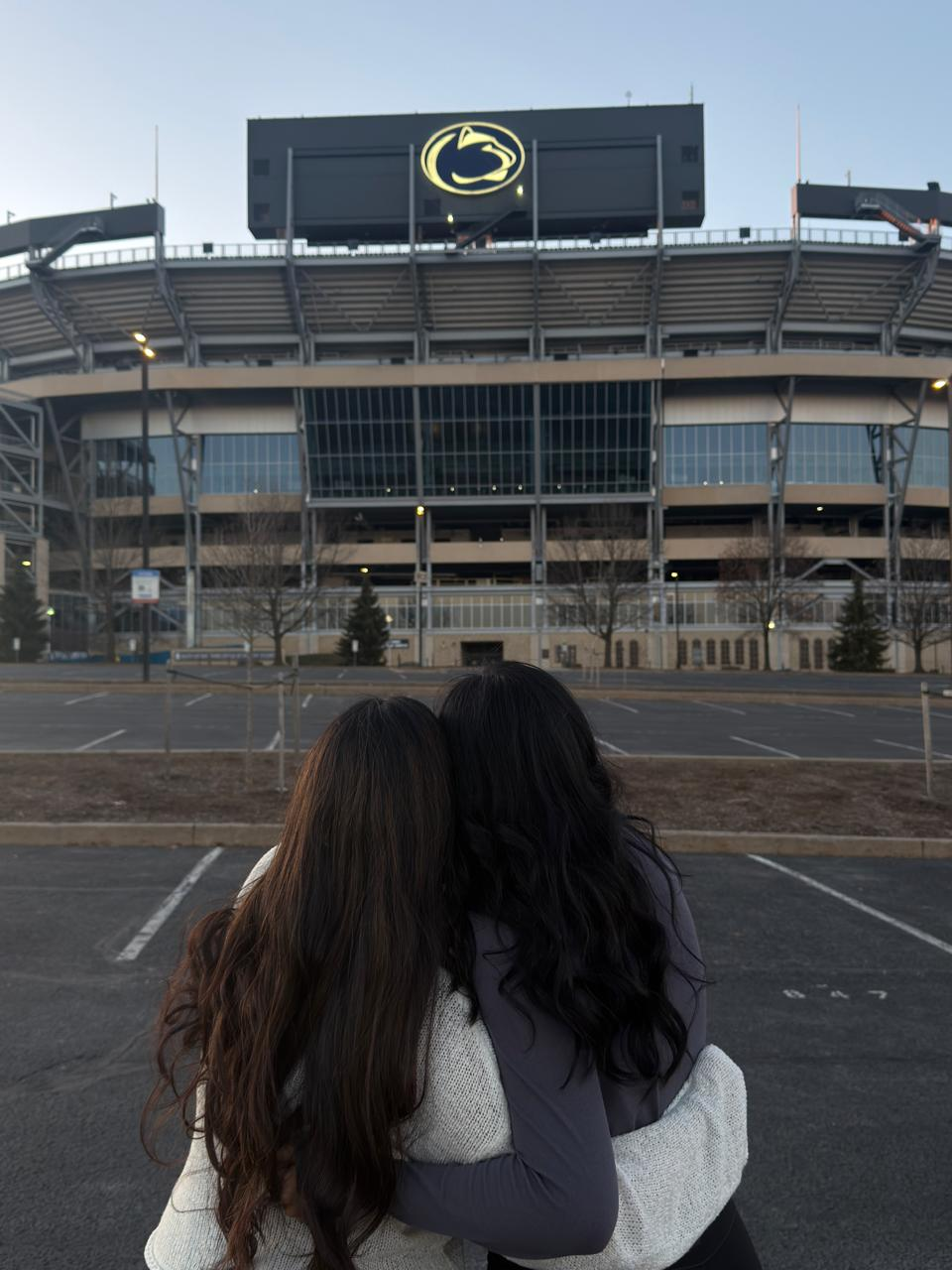

Hi, I’m Srinidhi. I went to high school in Bangalore, India, and studied at Neev Academy. I completed the IB Diploma Programme, now I’m at the Penn State Harrisburg Campus and will move to the main campus in 2 years. I’m currently pursuing a double degree in Biobehavioral Health and Health Policy Administration.
I’m currently in my freshman year, specifically in the second or spring semester. For me, the IB allowed me to transfer 20 credits to college. Technically, I could graduate a year early. But instead of rushing, I decided to stay for four years and use that credit advantage to complete a double degree.

My High School Academic Background
In 9th and 10th grade, I did the IB MYP Programme, where I focused heavily on science. I took biology and chemistry, along with all the other required subjects, including English Language and Literature, Integrated Humanities, Visual Art, Math Standard Level, Interdisciplinary Unit, and French (Phase 2).
For the IB Diploma Programme (11th and 12th grade), I took:
- Biology, Psychology, and English Language and Literature at Higher Level
- Math AI, Chemistry and French B at Standard Level
Doing French for all four years of high school allowed me to skip language general ed requirements here at university, so that is something I think those applying to U.S universities should consider.
I was always interested in health, neuroscience, and human behaviour. Biology and psychology together just made sense to me. I liked understanding both the science behind the body and the psychology behind behaviour.
I explored this further through my 10th-grade Personal Project, where I created a podcast focused on Neuroscience. It was a 2-year journey where I completed courses on the topic, conducted expert interviews and consolidated my learning into the final product of a 5-podcast series. This helped me truly begin understanding my passion in the field. I ended up scoring a perfect score of 7/7 for this project from the IB.
My Extracurriculars: Research, Hospitals, and Leadership
One of the biggest parts of my application was a neuroscience research paper I wrote in 10th grade through Lumiere Education. I worked with professors from Princeton and the University of Chicago, which was honestly one of my first real exposures to academic research. That experience for me validated that I liked working in health-related fields.
I also interned as a Data Analyst and Marketing Intern at a nutrition-based software company called Cordana Ecosystem. I worked with AI tools, nutrient tagging systems, and did a lot of data-based research. It was interesting because it combined health and technology, which is a skill that is more and more prevalently necessary across the job market as AI technology progresses, and the world becomes more digitised.
On the medical side, I did observership internships at Manipal Hospital, Baptist Hospital, and a government hospital in Bangalore. At the government hospital, I interned and observed for six weeks, which allowed me to get certified in the ACE-3 cognitive testing tool. This acted as an important professional exposure for me as I administered cognitive tests to patients to assess impairment levels, allowing me to get unique hands-on experience in my field of interest.
I also worked in remote villages in India collecting data on non-communicable diseases. I would go with doctors and nurses, gather information, and input everything digitally. That gave me real exposure to public health and how healthcare systems work outside of private hospitals, which allowed me to gravitate towards public health for my second major in college.
Outside academics, I was very involved in leadership and activities in my school:
- Student Council (Class Representative and Executive Council Programme Director in my junior and senior years, respectively)
- School Dance Club Founder and President (4 years)
- School Choir (2 years)
- School Model UN Senior Volunteer (1 year)
- Literature Festival Senior Volunteer (4 years)
- Youth4Change Co-Founder (2 years)
- Project Tisya (in collaboration with Dreams from Islam in Africa) with another student based in Delhi
My activities were a mix of research, service, leadership, and creativity, which emanated across my profile. I think the diversity and academic focus in my application is what stood out in terms of my extracurriculars, as I showed my academic passion and growth, alongside my character as a person very involved in my school community.

My Application to Penn State
I applied to Penn State through the Common App under the 2+2 program. Penn State has 20 Commonwealth campuses and one main campus. The 2+2 program allows you to spend two years at a smaller campus and then transfer to the main campus at University Park for the last 2 years.
I chose this path intentionally as I knew that the University Park campus would feel huge. I felt like I might get lost in that environment as a freshman, which is why I wanted smaller classes, more access to professors, and fewer people competing for the same opportunities as me, as there was a lower likelihood of someone being on the same academic pathway as me.
Penn State has rolling admissions, so I didn’t apply ED or RD. It was just a rolling application process.
For my Common App essay, I wrote about trypophobia—my fear of clusters of holes or circular patterns. I used it as a metaphor for my personality. I wrote about how I struggle when things aren’t structured or perfect, and how that fear of imperfection shaped me. But I also talked about how I’ve learned to grow from imperfection rather than avoid it, and let it consume my life entirely.
For my Penn State supplemental, I wrote about pasta. Specifically, different shapes of pasta and how each one represented different parts of my identity. It sounds random, but it was deeply personal and creative.
I took the SAT, but Penn State was test-optional, so I didn’t submit my scores there. I only submitted my English score to colleges that required it.
Starting at Penn State Harrisburg
Right now, I’m studying at the Penn State Harrisburg campus, which is one of the Commonwealth campuses located in Pennsylvania’s capital. In my third year, I’ll move to University Park, the main campus, to complete the last two years of my degree.
Starting at a smaller campus was one of the best decisions I made. I get to interact with Professors in a more personalised manner, and they know who I am. It’s easier to get research opportunities and internships because fewer students are competing for the same roles. I don’t feel like just another number in a lecture hall of thousands. It was also easier to make friends, as in a small, tight-knit campus, everyone knows everyone.
This opportunity also gave me the chance to explore different locations during my undergraduate journey, allowing me to engage with people from different backgrounds and build a broader yet personal network of people through my undergraduate studies. Networking is a crucial component of pursuing an undergraduate degree, as these people are bound to engage in professional landscapes of all kinds, and later in life, knowing them could be helpful both personally and professionally.
Living Off-Campus and Adjusting to Independence
I live off-campus in an apartment with three roommates, who I connected with before coming to university through social media. Here, it is not really a typical “college town.” It is just the campus and nearby housing. Other than that, the space is quite suburban and empty, but in a nice, calm way.
Living with roommates has been my biggest adjustment. Back home in India, I lived with my family, and we had help with chores. Here, I’ve had to learn everything—taking out the trash, cleaning shared spaces, cooking, and being responsible for myself.
I also learned how important communication is. When you live with other people, you can’t avoid difficult conversations, and you have to be mindful that it is a shared space and not just one person’s house. If someone isn’t cleaning up or isn’t communicating properly, it affects everyone as a whole.
At the same time, living together is fun. We walk to campus together often. If someone makes food, she’ll share it with everyone. We buy coffee for each other. It feels like a shared lifestyle, which is something new and unique compared to high school.
Academic Life in College
Academically, college is very different from high school. Everyone is studying something they actually chose. So when we sit in the library for four hours preparing for an exam, it doesn’t feel forced. People genuinely want to do well because they enjoy what they are majoring in.
The IB helped me so much when it came to college. Because I transferred 20 credits, I didn’t have to take many general education classes, which allowed me to directly jump into coursework related to my major. I skipped the extra language requirements because I took one language throughout high school, and reduced the math requirements because of my final IB scores. That credit advantage allowed me to pursue a double degree without increasing my course load compared to my peers. I take 6 classes, and they are all related to public health and biology.
One downside of college is that skipping class is very easy. If you skip once, it becomes a habit. I’ve definitely experienced that with one large lecture class, mainly because I don’t have friends in that class. That’s why scheduling and discipline are extremely important.
My Advice to Students
If I had to give advice, it would be this:
Apply for everything. At a big university, thousands of students apply for the same position. If you apply to twenty opportunities, your chances increase.
Join clubs—even ones unrelated to your major. I joined the entrepreneurship club even though I’m not a business major. It’s about gaining exposure and building an undergraduate network.
Plan your semester early. Decide which clubs you want to join, which commitments you’ll take on, and manage your time from the beginning. If you decide to join clubs in the middle of the semester, it may feel difficult and uneasy to mesh in, but it’s not impossible.
Don’t let friends distract you. Everyone has different majors, different workloads, and different goals. Just because someone else isn’t studying doesn’t mean you shouldn’t be. College isn’t like high school—you’re all on completely different paths.
And most importantly, take responsibility for yourself.
No one is forcing you to attend class. No one is forcing you to study. Your success is fully in your hands.
Being at Penn State has taught me independence, discipline, and how to navigate a completely new environment. Starting at a smaller campus gave me confidence, and eventually transitioning to the main campus feels like a natural next step.
I came in knowing I was interested in health. Now, I’m building both the scientific and policy side of that interest—and doing it on my own terms.