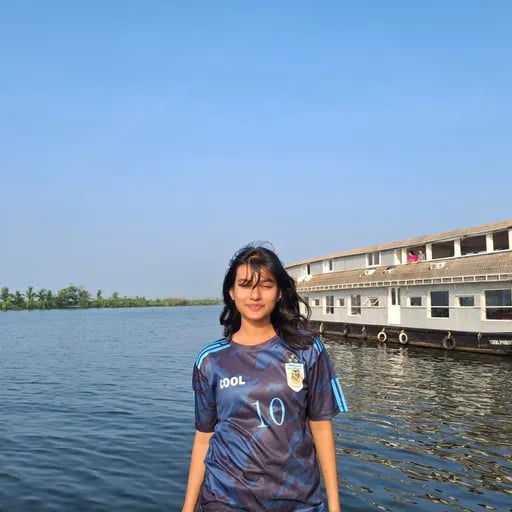


Hi, I’m Mariana. I’m 17 years old. I’m from Brazil, and I’ve been attending a Brazilian school since I was about 4 years old. For as long as I can remember, I’ve wanted to study abroad.
This summer, I got the chance to experience what that might actually look like when I attended the University of Chicago’s summer programme. I chose the Law and Social Impact course, although when I applied, I also selected Healthcare and Economics as two of my other choices.
For me, the programme was about much more than spending a few weeks at an American university. I wanted to see what studying in the United States actually felt like, explore a subject I was interested in, and figure out whether UChicago could be somewhere I saw myself in the future.
I’m still not completely sure what I want to major in. That is one of the reasons I wanted to do the programme in the first place.
Applying to UChicago Summer
The application itself was fairly straightforward.
I submitted my SAT score (1470), my transcript, extracurricular activities, and supplemental essays. I did not submit an English proficiency test because the programme stated that students who could demonstrate sufficient English proficiency through their application did not necessarily need to submit one.
The essays asked why the programme would be important to me and how it would be useful for my future. At first, that might sound like a standard application question. But I think it forces you to think about what you actually want from a summer programme.
I wasn't applying just because UChicago was a prestigious university. I wanted to use the programme to explore something I had not studied in depth before and to understand what life at an American university would actually be like.
My academic record was strong, although Brazil does not use the same GPA system as the United States. Our grades are generally scored from one to ten. In tenth grade, my final grade across all subjects was 9.9 out of 10. In eleventh grade, which was more difficult academically, I finished with a 9.75 out of 10.
I genuinely love studying, so academics have always been an important part of my life. But I also knew that grades alone would not make my application stand out.
The five extracurriculars I submitted
One of the things I remember most clearly about the application was having to choose only five extracurricular activities.
That meant I had to think carefully about which parts of my life I wanted the admissions team to see.
The first was my role as an international ambassador at my school.
Our international counsellors selected a group of students to act as role models for younger students and to help with the school's international department. Whenever representatives from schools and universities visited, we would introduce them to the school and help them interact with younger students.
We also helped other students navigate the international application process.
I gave SAT classes, spoke to younger students about applying internationally, wrote newsletters about applications, and shared information about SAT and TOEFL preparation and summer programmes.
Being an international ambassador meant that I was not just preparing for my own international education. I was also helping other students understand how to pursue theirs.
The second activity I listed was BandInvest Investing, an investment club at my school where I was a coordinator and co-head.
I taught younger students the principles of economics, including basic macroeconomics and microeconomics, as well as topics such as company valuation. We also invited professionals to speak to the club. We brought in someone from McKinsey and the CEO of a major Brazilian bank, among other speakers.
The club was mainly made up of tenth-grade students, while the eleventh-grade students were responsible for teaching and organizing the sessions. For me, it was an opportunity to take something I was learning academically and turn it into something I could explain to someone else.
The third activity was volleyball, which has been part of my life for as long as I can remember.
My older sister loved volleyball and, in a way, pushed me to start playing too. I began playing officially at a club in eighth grade and have continued ever since. In ninth grade, my team placed third at the state level, and last year I won an MVP title.
But what I wrote about volleyball was not only about the awards. The sport taught me something about relationships. There is a particular kind of relationship you develop with teammates and coaches where people care about you, but that does not necessarily mean they make things comfortable for you. Sometimes, caring means pushing someone harder.
A coach might want you to improve so badly that they refuse to let you settle for what you can already do.
I learned that there are different kinds of connections with people. Not every meaningful relationship is built around comfort. Sometimes, someone showing that they believe in you means challenging you to become better.
The fourth activity I mentioned was dance.
I have also danced for as long as I can remember, and I have included some of the awards I have received through dance. Like volleyball, dance has taught me lessons that go beyond the activity itself. Both have changed the way I think about connection, discipline, and the things I am capable of doing.
My fifth activity was perhaps the one that felt most personal.

The women selling food on the streets
In Brazil, it is common to see women selling breakfast food on the streets.
I started noticing them everywhere. At first, I was simply curious. Eventually, I began talking to some of them. I learned that many of these women were selling food because they needed to support their families financially. They were working to get by, but I also noticed that many of their small businesses did not have much formal structure. They were selling products, but they often weren't calculating their profits.
They weren't necessarily tracking how much money was coming in or how much was going out. Some were even choosing their prices by simply copying what another vendor was charging because they did not know how to determine the appropriate price themselves.
I started talking to other girls about this, and together we created a booklet with basic business information. We explained how to structure a small business, calculate and track profits, monitor spending, and think about pricing. We also helped them work on their storytelling and figure out what made their particular business different from the other vendors around them.
Essentially, we were helping them identify their unique value proposition. The project started because I kept seeing the same woman selling food every day and became curious about her life.
It reminded me that sometimes an extracurricular activity does not begin with a perfectly planned initiative.
Sometimes, it begins with noticing something.
Your recommendation letter matters more than you think
If there is one part of the application process I would emphasize to other students, it would be recommendation letters.
Almost everyone applying to competitive programmes is going to have good grades.
Almost everyone will have impressive extracurricular activities.
What differentiates applicants is often the way they communicate who they are through their essays and the people who can genuinely speak about them through recommendation letters. If you have an excellent academic record and strong extracurricular activities, but your teachers cannot support the picture you are presenting, your application may feel incomplete.
I think recommendation letters are particularly important because they provide a perspective that you cannot provide about yourself.
For UChicago Summer, I did not have a lot of time to prepare my application. I decided to apply relatively late, and because my teachers in Brazil do not speak English, I would have needed to give the teacher more time to understand the format and expectations of an English recommendation letter.
Instead, I asked my counsellor.
I do not know exactly what she wrote because students generally cannot see their recommendation letters, but I am confident that she was able to talk about my involvement as an international ambassador because she supervised me in that role.
She could also speak about my investment club involvement because she was actually the person who created the club. She has a degree in economics from UChicago, so she knew the university and could speak specifically about my involvement in an area that connected with my interests.
That made her recommendation particularly meaningful.
I came to UChicago still unsure about my future
I chose Law and Social Impact because I wanted to explore whether law might be something I wanted to pursue after my undergraduate degree.
I went into the programme without knowing whether I wanted to become a lawyer. The course allowed me to explore that question properly. We learned about democracy, policy implementation, and the ways discrimination can still exist within legal systems. We also discussed why those systems need to be challenged and how we can work towards preventing discrimination.
I loved the academic experience.
But I also came away with an answer. I don't think I want to become a lawyer. That might sound like the opposite of what a summer programme is supposed to accomplish, but I actually think it is one of the most valuable things the programme gave me. I learned more about a subject I was curious about and discovered that I could enjoy studying something without necessarily wanting it to become my career.
I am still exploring.
And I think that is okay.
At seventeen, I don't think I need to have every part of my future decided. Sometimes the purpose of exploring a new field is precisely to discover what you do not want.
My first experience of American campus life
One of the best parts of the programme was meeting people from completely different backgrounds.
There were students from Singapore, India, China, Japan, and many other places.
Everyone came with different experiences, different cultures, and different ways of thinking. I found that exciting because people don't just bring different nationalities with them. They bring different kinds of knowledge and different ways of understanding the world.

Everyone had something that I didn't know. Socially, I found people incredibly open. Everyone seemed willing to meet new people and talk to them. I did not feel like people were closed off or unwilling to engage.
For someone coming from another country, that made the transition much easier. But there was still a culture shock.
I knew English before I came to the United States.
I could communicate. I could participate in class. I could have conversations. But that did not mean that English felt natural all the time.
Your native language comes with its own expressions, slang, and ways of communicating emotions that do not necessarily translate directly.
In Brazil, for example, we have an expression that essentially means, "Life isn't a strawberry." It means that life isn't always easy. But how do you explain that exact feeling to someone in English? You can translate the words, but you lose the cultural meaning behind them. That was one of the biggest things I noticed. Knowing a language is not the same thing as living inside that language.
You have to learn how people actually communicate, joke, express themselves, and understand one another.
That takes time. I also missed Brazil. At one point, I tried cooking a traditional Brazilian dish because I wanted to recreate something familiar and ease that feeling of missing home. That helped. I think international students need to understand that homesickness is not necessarily a sign that they are having a bad experience. You can love being somewhere new and still miss where you came from.
UChicago's library became part of the social life
Beyond the programme itself, I loved exploring the university.
The library was one of my favourite places. There are also a lot of cafés throughout campus, which made it easy to grab a coffee and head somewhere to study. What surprised me was how much people seemed to bond over academic stress.
At UChicago, the library almost felt like a social space. People were there to work, but there was also a sense of community around the fact that everyone was working hard. I started to understand what it might feel like to actually be a student there rather than simply someone reading about the university online.
And I could picture myself there.
That is something a university website cannot really tell you.
Why summer programmes can be worth it
Before attending UChicago, I thought of a summer programme primarily as an academic opportunity.
Now, I think of it as a way to test-drive a university. You can read every page of a university website and still not understand what it feels like to be there. A summer programme lets you experience the campus.
You can meet students from different countries. You can interact with professors. You can walk around the library, find the cafés, sit in classrooms, and see how students actually spend their time.
You also get to learn things about yourself. I applied to Law and Social Impact because I thought I might want to become a lawyer.
I left knowing that I probably don't. That is still a successful outcome.
Choose the university, not just the programme
My biggest advice for students looking at summer programmes is to choose the university strategically.
Think about where you might actually want to study in the future. If your dream university is UChicago, then applying to a UChicago summer programme can be particularly valuable. The university has an Early Decision-related opportunity associated with its summer programme, which makes the experience especially relevant for students who are serious about applying there. You can apply before the ED1 deadline as an ED0 applicant.
But the principle applies more broadly. If you love Brown, look into Brown's summer opportunities. If you are interested in Columbia, explore what Columbia offers. Penn has strong summer programmes too.
The point is not simply to attend the most prestigious summer programme you can find. Choose somewhere you are genuinely interested in.
That way, the programme gives you something beyond a line on your application. It gives you information. You can learn what the university feels like. You can decide whether you actually like the environment. You can learn more about the academics.
And when you eventually apply, you will have a much more authentic understanding of why you want to be there. For me, that is what UChicago Summer ultimately became.
I came to Chicago still figuring out what I wanted to study.
I left with a clearer idea of what I did not want to study, a better understanding of American university life, new friends from around the world, and a much stronger sense that I could actually imagine myself studying abroad.
I still don't know exactly what my future major will be.
But now I know that figuring it out can be part of the process.