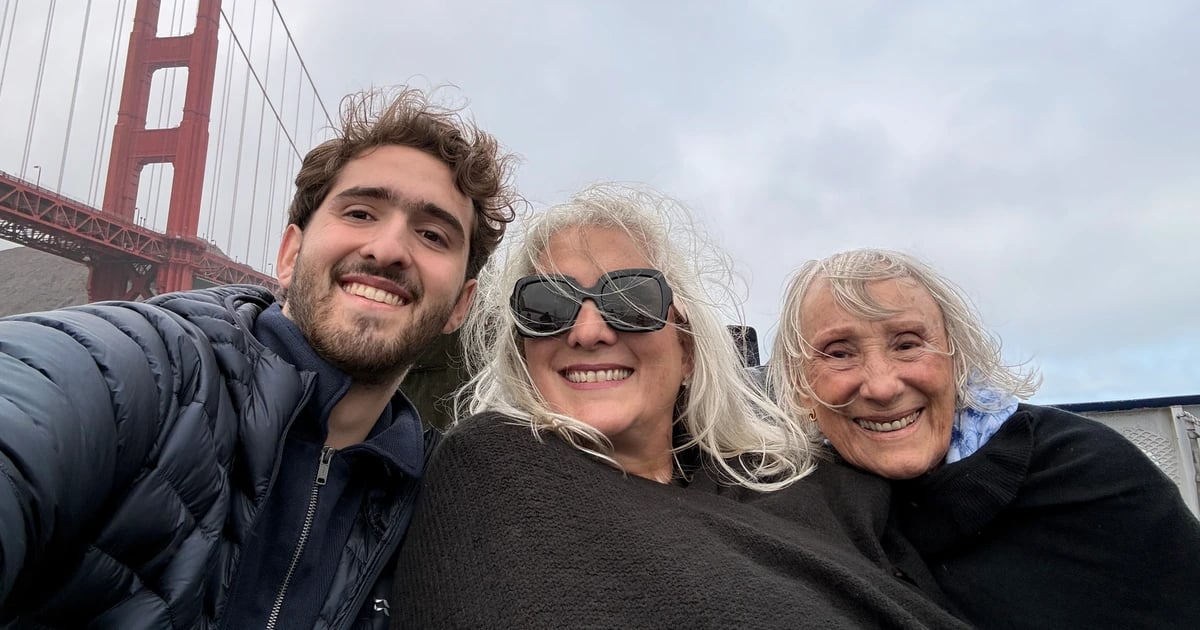

For Julián Tamayo Lopez, studying bioengineering at Stanford University was the result of several experiences that began long before college.
Growing up in El Salvador, Julián attended Escuela Americana de El Salvador, an American-curriculum K–12 school with about 1,200 students overall and roughly 78 students in his graduating class. The school placed a strong emphasis on preparing students for universities in the United States, and many of Julián’s relatives had also studied abroad.
By middle school, the idea of attending an American university had become a concrete goal.
“I think my first memory of studying abroad was probably somewhere between sixth and eighth grade,” Julián said. A school project asked him to research either Princeton or Harvard as his “dream college.” Watching older students from his school graduate and leave for American universities further reinforced the possibility.
But while Julián knew he wanted to study in the United States, he had not yet decided what he wanted to study.
That changed through an experience much closer to home.

Discovering Bioengineering Through Prosthetics
Julián’s first major exposure to bioengineering came through Teletón by Funter, a center in El Salvador that serves people with disabilities. He initially volunteered there because he needed volunteer hours for high school graduation; however, he chose Teletón, however, because he wanted to work somewhere where he could directly help people.
His first responsibilities included building wheelchairs on Saturdays, later taking on a more intensive role: where he spent time at the center repairing wheelchairs that had been incorrectly constructed or had developed problems.
The technical work interested him, but interacting with the people receiving care had an even greater impact. Julián observed rehabilitation and therapy for people who had experienced limb loss. Seeing how engineering, medicine, and rehabilitation could intersect led him toward prosthetics.
He also became a translator during a CPR and Heimlich training session led by American instructors because he was one of the few English speakers available. These experiences gave him an early understanding of what engineering could accomplish outside a classroom.
“I think that was kind of my gateway into bioengineering,” he said.
When Julián arrived at Stanford, he initially expected to focus on prosthetics. His coursework and other opportunities, however, introduced him to a much broader field.
“It's such a broad field,” he said. “You can do prosthetics, genetics, medical imaging, so many different things.” Now a Stanford bioengineering student in the Class of 2028, Julián has continued exploring different areas of the discipline rather than limiting himself to the field he initially encountered in high school.
Preparing for American Universities
Julián entered the college application process with a strong academic background.
His highest SAT score was 1560, and his weighted GPA was approximately 100.7. His coursework included AP World History (5), AP U.S. History (5), AP Comparative Government (4), Calculus AB (4) and BC (4, AB Subscore 5), AP Biology (5), AP Spanish (5), AP Spanish Literature (5), and AP English (5) as well as dual-enrollment chemistry and physics.
His academic preparation was only one part of his application strategy. Julián believes that students applying to highly selective universities should understand that strong grades and test scores are often shared by many applicants. Once students have demonstrated that they can handle rigorous academic work, he believes other parts of the application become important, particularly extracurricular activities, essays, and the way students approach problems.
“What makes you different?” he asked. “What is your substance?”
He also questioned what happens when applicants become too focused on academics alone: “What if you're boring?”
For Julián, that meant developing interests outside the classroom and being able to explain why those experiences mattered. During high school, he served as president of his school’s National Honor Society and as class president: he also participated in varsity basketball and Model United Nations, served as vice president of his G Leaders Club, and worked on projects including an aquaponics project and a proposal to install solar panels across his school campus. His activities were not all directly related to bioengineering. Instead, they gave him opportunities to demonstrate leadership, initiative, and interests beyond his academic record.
Applying to 28 Universities
Julián ultimately applied to 28 universities.
He acknowledges that the number was excessive and that the process was extremely stressful, but he also found value in writing so many applications.
The supplemental essays alone became a major project. At one point, Julián had an 80-page document containing his supplemental responses.
Writing that much forced him to repeatedly examine his experiences, interests, and goals. The process, he said, taught him a lot about himself and helped him become a stronger writer.
Julián also had considerable support during the process. His school worked with Blue Ivy Coaching, which provided him with two SAT coaches and a personal essay coach, in addition to his school's college counselor. Despite the support, the application process was demanding. Some of his essays were completed on their deadlines, something he now considers a big mistake. His advice to future applicants is straightforward: start earlier than you think you need to.
A first draft does not have to be good, he said. What matters is giving yourself enough time to revise it.
Why Stanford?
Julián had always expected that he would seriously consider Stanford if he were admitted. Once he received his acceptance, however, he still wanted to experience the university before making his final decision.
One factor that made Stanford particularly meaningful was an unexpected family connection. Julián’s grandmother attended high school in Palo Alto decades ago, giving him a personal connection to the area that he had not initially expected. He attended Stanford's admitted-student weekend and quickly found himself drawn to the university.
By the end of the first day, Julián remembers thinking, “This is the place.”
The people were one of the biggest factors; another primary factor was Stanford's interdisciplinary approach to education.
For Julián, choosing a university was not simply about finding the strongest program in one subject. He wanted an environment where he could study bioengineering while continuing to explore other academic disciplines: Stanford's general education requirements and flexibility across fields appealed to him because they encouraged students to develop interests outside their majors.
That interdisciplinary environment has since influenced the way he thinks about bioengineering itself.
Learning What Bioengineering Can Be
One of Julián's most memorable academic experiences at Stanford involved a plant.
During his admitted-student visit, he saw a genetically modified petunia in Stanford's bioengineering building. Professor Alex Engel showed him the plant, which produces visible light.
A year later, Julián encountered the plant again in BioE 80, where students received their own Firefly Petunias.
For someone who had entered Stanford primarily interested in prosthetics, the experience represented a much broader side of bioengineering: using biological systems and genetic engineering to create entirely new capabilities. The plant is still alive in Julián's room.
More importantly, experiences like this have changed the way he approaches his major. Rather than seeing bioengineering as a single career path, he now sees it as a field connecting engineering, biology, medicine, genetics, imaging, and other disciplines. His interests have expanded accordingly.
He entered college convinced that prosthetics were his primary interest. Since then, he has explored genetics and medical imaging through Stanford courses and summer opportunities.
Adjusting to a New Academic Environment
The transition from El Salvador to Stanford was also an academic and cultural adjustment.
Julián had attended a relatively small high school where students knew one another well and frequently collaborated. Stanford was significantly larger and brought together students from many different backgrounds. He also had to adjust to a new approach to classroom collaboration.
Julián expected an intensely competitive environment. Instead, he found that many of his classes were highly collaborative. In difficult chemistry courses, for example, students shared notes and helped one another understand difficult material. Rather than viewing classmates simply as competitors, Julián found himself surrounded by students asking, “How can we all get through this together?”
That was similar to the culture he had experienced at Escuela Americana. During the college application process, students shared supplemental essays and gave each other feedback.
Julián described the high school environment as “us versus the colleges,” rather than students competing against one another.
That collaborative mindset became one of the things he valued about studying in the United States.
Building a Community Far From Home
Socially, the transition took longer.
Julián said that he spent much of his first quarter gradually becoming comfortable with his new environment. His roommate and friends from his freshman dorm helped him adjust, and many of those friendships remain important to him today.
For international students, Julián emphasizes that adapting to a new country and university takes time.
“You have to give yourself time,” he said.
His advice is to make concrete efforts to interact with people rather than waiting for friendships to happen automatically. Even something as simple as saying hello can help. He also noticed smaller cultural differences. In El Salvador, Julián was accustomed to greeting people with handshakes or cheek-to-cheek greetings, while greetings in the United States often involved more physical distance.
These differences initially reminded him that he was far from home. Over time, however, being abroad changed his relationship with that home.
Becoming More Comfortable With His Identity
Growing up in El Salvador, Julián had been proud of his English and wanted to eliminate his accent so that he could sound as American as possible.
After moving to the United States, his perspective changed: his accent became a connection to El Salvador rather than something he wanted to remove. Now, he appreciates moments when his pronunciation sounds different because they remind him of where he came from.
In that sense, studying abroad gave Julián something he had not expected to gain from attending an American university: a stronger connection to his own background.
His academic interests have also changed since leaving El Salvador. He arrived at Stanford with a specific interest in prosthetics and has since discovered genetics, medical imaging, and other areas of bioengineering.
For Julián, studying abroad has therefore been both an academic expansion and a personal one. He left El Salvador with a goal of studying bioengineering in the United States. At Stanford, he has continued to broaden his understanding of what that field, and his own future within it, could look like.
Advice for Future Applicants
Looking back on his application process, Julián has one piece of advice above all: start early.
Students do not need to know exactly what they want to write before beginning an essay. Starting with an imperfect draft gives them time to understand what they actually want to say and revise it.
He also encourages students to think beyond grades.
Strong academics are important, but Julián believes students should develop interests and experiences that allow them to understand what they care about and communicate that clearly.
Most importantly, he says, students should use the application process as an opportunity to learn about themselves.
His own 28-school application process was stressful, but the hundreds of hours he spent writing and revising ultimately forced him to think more carefully about his experiences, interests, and goals.
For a student considering studying abroad, that process can begin much earlier than senior year: by exploring academic interests, pursuing meaningful activities, and learning how to explain why those experiences matter.