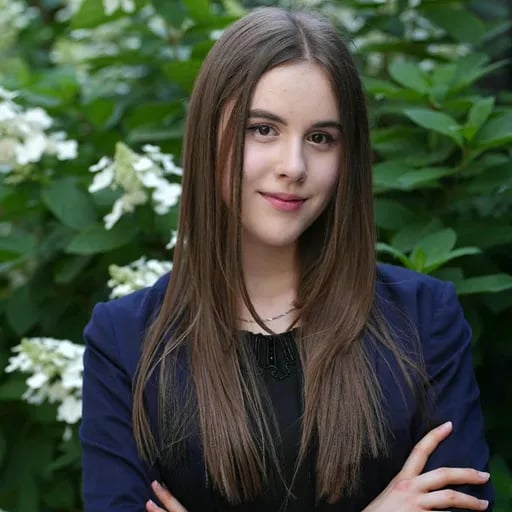


Hi! My name is Amelia, and I will be pursuing my Bachelor’s degree at University College Maastricht, specifically in Psychology, Science and Technology Studies (STS), and Digital Enterprise. It's a combination that might sound unusual at first, but it reflects exactly who I am: someone fascinated by how the mind works, how people grow, and how technology can be used to support both.
Where it all started
I grew up in Warsaw, the capital of Poland, and attended a public high school there. From a very young age, I knew I wanted to study abroad. It was something I felt certain about early on, and I started preparing for it long before most people even think about university. In fact, I began saving money for my studies abroad back in 8th grade.
Part of what pulled me toward international education was the problems in the Polish educational system, which operates on the Prussian educational system. This system might have made sense centuries ago, but in practice, nowadays it does not function effectively. It shapes members of society to be “useful to the government and the state.” In other words, education is intended to specialize students so that the individual is useful to the state while remaining neither self-sufficient nor independent.
The Prussian education system does not foster the development of a democratic society capable of solving problems on its own; instead, it prioritizes narrow specialization and the division of society into groups to ensure it remains easily manageable.
I wanted to escape this system and develop skills like critical thinking, fluency in communication, an interest in the world, and an interdisciplinary view on real problems, which is unfortunately something the old system fails to develop in youth.

Insight into my academic profile
I did not take any exams like the SAT or any international diploma program, just the Polish final exams (matura). Interestingly, my matura score didn't actually factor into my university acceptance, as Dutch universities like UCM instead evaluated my grades across all four years of high school.
In my last year, my grade average was 4.8/6, which is quite high for Polish students.
Since my studies would be in English, I also needed to prove my language proficiency for my applications. I sat the Cambridge CAE exam and received a certificate confirming competence at C2 level. Technically, though, the CAE tests up to C1 Advanced, so my official certificate is a C1 diploma.
Extracurriculars:
I founded an app called AURECA, a platform for cognitive wellness and mind education. It teaches people to recognize automatic reactions to stress, uncertainty, and discomfort, and then helps them practice acting in accordance with their values. The reason for those bad habits is that we have been impeding our tolerance for things requiring extra effort. We optimize even the smallest friction and foster a dopamine-driven culture. Therefore, our lives feel much harder and more uncomfortable.
This is exactly why I created AURECA, so that people can strengthen their resilience and their ability to overcome challenges. Nowadays, we need to practice conscious responses to this discomfort to stay aligned with our values - before our life becomes dictated by what is too hard to handle.
I am a Brand Representative for Zwolnieni z Teorii, Poland's largest nationwide Olympiad and educational platform, where secondary school and university students gain practical skills by implementing their own social projects. I created a project earlier as part of the Olympiad. I later took part in their local route around Poland, promoting entrepreneurship and active community service among young people during presentations at schools. I also recruited partners for the foundation, including educational institutions and individuals. I was additionally a member of the Golden Wolves Commission – a prestigious award for the best social projects in Poland implemented as part of the ZWZT Olympiad.
Additionally, I am an associate for Women Emerging, as part of their Expedition for Higher Education. There, I work in a group of 26 impactful women who explore their core values, essence, elements and expression, all while focusing on how the energy we produce and the skills we bring to the table influence our colleagues and the projects we lead.
Why University College Maastricht?
I applied to 5 universities in the Netherlands, but my top choice was University College Maastricht. The application process was not as tedious as at other universities, as I did not need to write any additional essays or take entrance exams. I really liked how UCM is up to date, as they add new courses every year. I also knew early on that I didn't want to attend an HBO institution, which is a university type that leans heavily into applied sciences and career-specific training. I wanted something broader and more exploratory. UCM's liberal arts and sciences structure gave me that flexibility.
Beyond academics, I was drawn to the sense of community UCM offers through its student organizations. I'm especially looking forward to trying windsurfing through the university's sports club and the public speaking debate club. Anyone can start their own club, and I am really looking forward to exploring the options and eventually starting my own community in UCM.
One big drawback to studying in the Netherlands, however, is that scholarship opportunities are limited compared to some other countries, so I'm financing my own tuition.
Why not somewhere else?
I did receive offers from other schools, including the University of Groningen, and I was even accepted into Minerva University in the United States. Neither felt like the right fit for me. Minerva, in particular, was tempting on paper, but the financial reality of studying in the U.S. made it an unrealistic option.
UCM, on the other hand, felt like it captured what I liked about the American college-based system, but without the insane price.
Studying in the Netherlands
Geographically, the move wasn't drastic. The Netherlands isn't far from Poland, so I didn't experience the kind of culture shock that comes with moving to a completely different continent. Still, university life at UCM is so active that after just one week, it genuinely felt like a month had passed. There were so many events, activities, and parties packed into those first days that adjusting to the pace became its own small challenge, especially since that level of constant social activity wasn't something I was used to.
The documentation process to live in the Netherlands, however, was a lot, as right away you have to apply for a Citizen Service Number (BSN), which is required for everything. You can’t even get a card from a bank without the BSN, file taxes, work, or apply for healthcare. The rest of the process was not that bad, as I did not need to apply for a residence permit or visa, since I am from an EU country.
Looking Ahead
Choosing to study abroad was a decision I made almost a decade before I actually got on the plane. Looking back at everything, like the savings, exams, projects, and applications, feels like it was quietly building toward this moment. University College Maastricht wasn't just the university that accepted me; it was the one that matched the kind of student and person I was hoping to become.