A Quick Introduction to Who I Am
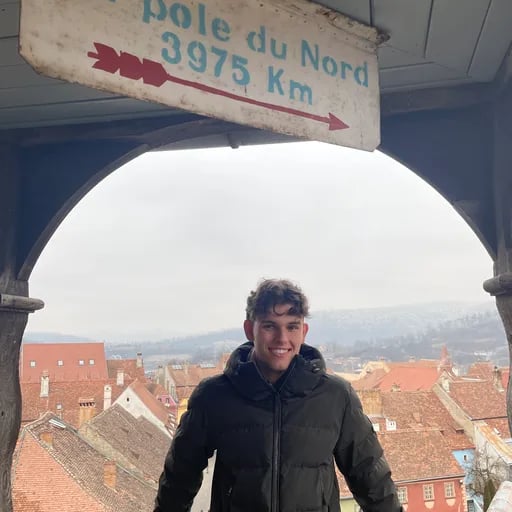
Hi! My name is Thijmen. I’m 22 years old, and I’m originally from Rotterdam, the Netherlands, although I currently live in Cluj-Napoca, Romania, where I’m completing my master’s degree in Diplomacy
Back in the Netherlands, I studied European Studies at The Hague University of Applied Sciences, within its Management and Organization faculty. Now, I’m pursuing a master’s degree in Cultural Diplomacy and International Relations at Babeș-Bolyai University in Cluj-Napoca, within the Faculty of European Studies.
Outside of my studies, I really enjoy cooking, learning foreign languages, and travelling. My family is Dutch, but interestingly enough, I’ve always had quite a strong connection to Romania, mainly because of the people I met during my university years in the Netherlands.
How I Started Learning Romanian
When I started studying European Studies in the Netherlands, I found myself surrounded by Romanian students. There are actually a lot of Romanians studying at Dutch universities, particularly in European Studies programs.
I initially became friends with a group of Romanian students who introduced me to even more Romanians. Before I knew it, I had an entire circle of friends who were Romanian. The only problem was that I didn’t speak Romanian at all back then. I could speak French, English, and Dutch, but Romanian was completely new to me.
At some point, I jokingly told my friends that I was going to learn at least a few words from them. I wanted to be able to say something in Romanian and maybe join the conversations they were having around me. What started as a joke gradually turned into something I took quite seriously. I wanted to actually understand the language, so I started learning new words and the way grammar works,
Then, during my Erasmus experiences, I had the opportunity to pick up even more Romanian, particularly informal vocabulary and expressions that I could use in everyday situations, and by that point, I could already speak Romanian reasonably well.
Why I Chose Romania for My Erasmus Exchange
At my university in the Netherlands, Erasmus was a mandatory part of our studies. As Dutch students enrolled in my program, we were required to spend one semester abroad, which meant approximately four months in another country. My degree lasted four years, and the exchange took place during the first semester of the third year.
To help us decide where to go, the university organized information sessions during which country coordinators presented the different universities available to us. Every student had a coordinator they could contact if they had questions about their destination university or needed help with anything related to their exchange.
My own coordinator was actually Romanian. She gave a presentation about Bulgaria and Romania, and I became particularly interested in Romania. She was also quite familiar with Transylvania, so she presented the region in a really appealing way. By that point, I had already visited Romania several times with my Romanian friends, who had taken me to meet their families. Therefore, Romania wasn't an entirely new destination for me.
I was really curious about what university life in Romania would be like, what courses I would take, and how the professors and academic environment would differ from what I was used to in the Netherlands.
However, one of the main reasons I decided to go with Romania was the academic program itself. The courses offered in Romania seemed more focused on diplomacy, interregional governance, and politics, which were subjects that I was really interested in.
Another important factor in my decision was that I had never been to Cluj-Napoca before. In fact, I hadn't really explored Transylvania, in the northwestern part of Romania, either. I was very keen to discover this part of the country, so choosing Cluj felt like the perfect opportunity to combine my academic exchange with the chance to explore a new region I knew very little about.

Applying for Erasmus
When applying for Erasmus, we had to rank the countries we wanted to go to, putting our preferred destination first and the other options in order of preference. I placed Romania in first place, Bulgaria second, followed by the United Kingdom in third place, the Czech Republic in fourth, and France in fifth.
Of course, the final decision also depended on our grades. The higher your average, the better your chances of getting a place at the university and in the country you wanted to go to. So, even if you ranked a country first, there was no guarantee that you would end up there. In my case, I was actually the only student from my program who ranked Romania as their first choice.
Erasmus Funding and Finding Accommodation
Sadly, I had some problems with my Erasmus funding. The International Cooperation Centre at Babeș-Bolyai University in Cluj-Napoca submitted my application too late, which meant I missed out on approximately €1,400. I was supposed to receive around €390 per month, but I ended up having to cover all my expenses myself. Thankfully, I also received a student grant in the Netherlands. With that support, and my own money, I managed to get by quite well in Romania.
Finding accommodation was another challenge, as I wasn't familiar with the Romanian rental market. Eventually, I found an apartment in a newly built building in Cluj-Napoca. It had one bedroom, a bathroom, and a kitchen, measured around 30 square meters, and cost me 3,000 RON per month.
My Erasmus+ Experience and What I Loved About Romania
I think being a foreign student who could speak Romanian made my experience a little different. My professors found it special that I could communicate with them in Romanian, and I built close relationships with many of them. I still keep in touch with several professors from that period, which is something I really appreciate about my time here. One of them told me I could choose whichever courses I wanted, and she would make sure I could attend them. I was even allowed to take classes from other faculties, and that’s how I got the chance to study Romanian Language and Romanian Culture and Civilization.
I was also quite lucky because, during my third year, I had classes with first-year students. And we got along really well, as everything was new for all of us!
When it comes to grades, everything was quite relaxed for me. I remember volunteering to give a presentation for one of my courses, even though it wasn't required. The professor was so pleased with my work that she gave me a 10 and told me I no longer needed to attend classes! :))
Outside university, I got involved with ESN (Erasmus Student Network), which organizes activities for exchange students. I travelled to different Romanian cities with them and took part in social events, Erasmus activities, and celebrations of Romanian national holidays.
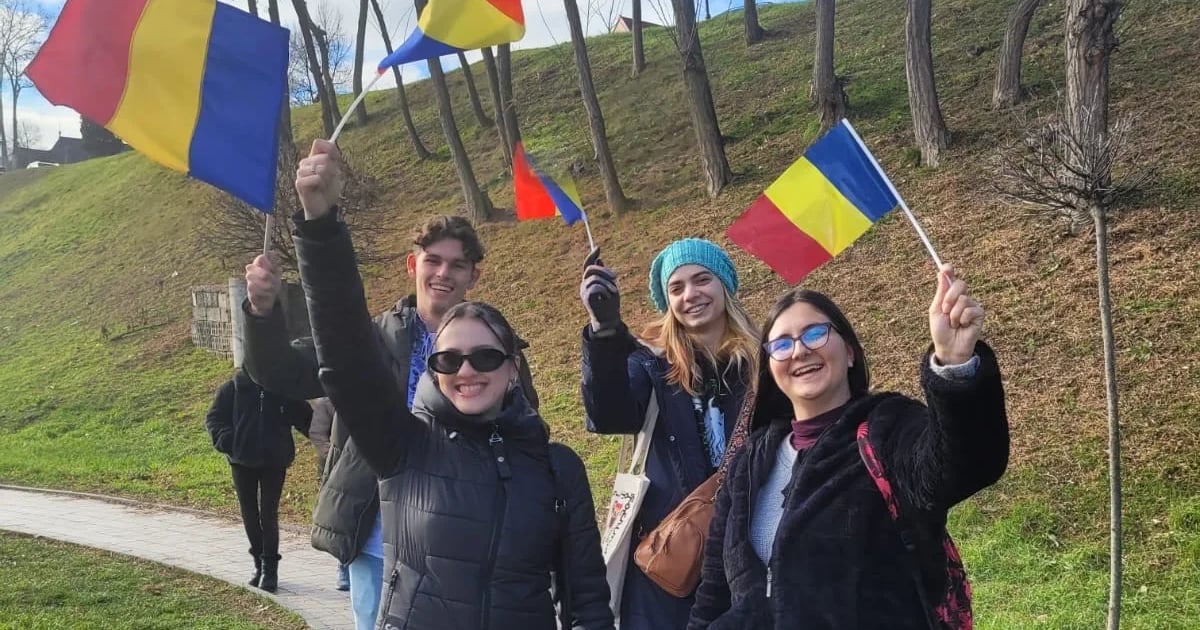
One of my favorite memories was going to Alba Iulia on 1 December, Romania's National Day. I went with a group of friends, and we all dressed in traditional Romanian costumes (ii) and bought a bunch of Romanian flags. We even took a picture together, all dressed up and holding our flags. It was a really beautiful experience. But beyond the university experience and the trips, one of the things I loved most about Romania was the hospitality. There's a real warmth to the way people treat you, and I found that incredibly lovely.

Why I Decided to Pursue My Master's Abroad
In the Netherlands, I completed my bachelor's degree at a university of applied sciences, where the focus is more on practical skills than academic research. Because of this, students who want to pursue a master's often have to complete an additional pre-master's program to adapt to the more academic teaching style.
In my case, I graduated with very good grades and completed an honors program, so I didn't see the point of spending another year and almost €3,000 on a pre-master's, especially when I knew students who were already enrolled in a pre-master’s program, and they would study things I had already studied during my bachelor's.
That's why I decided to look abroad for my master's. I wanted to continue my education without spending another year repeating material I already knew.
However, I graduated during the autumn exam session, which meant I had very little time left to find a master's program and enroll somewhere in time. I thought Romania would be a good option, especially since I had already researched the available master's programs there. So, I decided to look into my options and figure out where I could continue my studies.
The Application Process: A Lot of Paperwork and Bureaucracy
Honestly, the application process was probably the hardest part of moving to Romania. The university required a huge number of documents, some of which I had never even heard of before. In the Netherlands, things are much simpler, so I wasn't prepared for how complicated the whole process would be.
The Documents I Needed
The university initially asked me for several documents, including my bachelor's degree, officially recognized as equivalent to a Romanian diploma by the Ministry of Education, my birth certificate, a medical certificate confirming that I was fit to study, my passport and identity card, and proof of my English proficiency.
The birth certificate was probably one of the strangest requirements for me because, in the Netherlands, we don't really use birth certificates in the same way. I had never had one, and neither had my parents. However, I had a family record book that contained information about my parents' marriage and listed my sisters and me as their children. However, I couldn’t use that document because it also contained personal information about my siblings, which I couldn't share because of data protection rules.
I explained the situation to the university, and obtaining an alternative document from the Dutch authorities would have taken at least three weeks of administrative processing, followed by the time needed to send it to Romania. In other words, it could have taken at least a month, which was a problem given the short application period.
Proving My English Proficiency
As proof of my English proficiency, I needed a certificate such as Cambridge or IELTS. Initially, I was quite stressed about this because I didn't have either of those certificates, and there was no way I could obtain one within the available time.
Ironically, I had completed my entire bachelor's degree in English. After explaining this, the university agreed to consider my diploma supplement, which provided information about my degree and the language in which my courses had been taught.
Having My Dutch Diploma Recognized
In order to get my Dutch bachelor's degree recognized as equivalent to a Romanian degree, my documents had to be sent to the relevant authorities in Bucharest, and the whole process cost me 150 lei. I had to wait approximately two weeks for confirmation that my qualifications met the requirements for applying to a Romanian university.
I also had to provide my original high school diploma and transcript. Fortunately, my bachelor's and high school diplomas were already available in English, which made some things easier. Nevertheless, preparing and processing all the documents was expensive and time-consuming.
A Very Short Application Period
The application period ran from 10 September to 13 October, giving me only around five or six weeks to get everything done.
I spent at least 40 hours a week dealing with paperwork, visiting my doctor, contacting authorities, and trying to understand what else the university needed from me. I must have sent the admissions officer around 20 emails because I kept running into problems and didn't know how to solve them.
The staff were understanding, and they did try to make things easier in certain situations. However, the number of documents required was still overwhelming.
My Romanian Registration
Fortunately, I already had a Romanian registration certificate from my Erasmus exchange, which I had obtained by registering my address in Cluj for five years. This also gave me a Romanian CNP.
However, when the admissions officers found out, they started asking me questions about why I wasn't applying as a Romanian student if I already had a CNP. I had to explain that I was still Dutch and didn't have a Romanian ID card, passport, or diplomas. My registration certificate and CNP were the only Romanian documents I had, which made it difficult to provide some of the information they required.
The Language Barrier
In my opinion, I was quite happy to speak and understand Romanian. Although the admission platform had an English option, the required documents and forms were still in Romanian, often written in very formal, technical language. Sometimes, I struggled to understand exactly what certain documents referred to. I can only imagine how difficult the process would have been for someone who didn't speak Romanian at all.
Getting a Tuition-Free Place
As I said before, my grades from the Netherlands had to be converted to the Romanian grading system. My Dutch average of 7.5 was converted to an 8. I was surprised because I had graduated with honors, and I believed a fairer conversion for my average would have been a 9. At first, that scared me a bit, as I thought it would lower my chances of getting in.
Initially, I applied for a tuition-paying place because I didn't realize that EU students could also qualify for state-funded places. Luckily, one of my former Erasmus professors contacted me and explained that, with my average, I actually qualified for a tuition-free place!
Finding Student Accommodation
I was lucky enough to get a place in a student dorm through the medical and social criteria rather than the usual grade-based competition. I had to submit supporting medical documents, along with an application, a copy of my passport, ID, and my CNP.
Around 10% of dorm places are reserved for students applying under special criteria, including medical or social circumstances, or those who are orphans or have divorced parents. Since fewer students apply through this route, I had a better chance of getting a place.
In the end, I got a room shared with just one other person, and we even have a private bathroom. I pay 230 lei per month, which is a great deal.
Looking for a Job
Since the semester only started three weeks ago, I haven't found a job yet, but I'm planning to look for something online. I've managed to save enough money to get by for now, so I'm not in a rush, but I know I'll need to find work eventually.
How I'm Feeling About Life in Cluj-Napoca So Far
So far, I'm really enjoying it. The professors already know me as “the Dutch guy who left and came back,” which is quite funny. I also really like having a campus where so many of my friends are around. We see each other often, we're quite close, and we regularly spend time together outside classes. Having that kind of social circle makes me feel much more at home in Cluj.

My Advice
My advice is to choose the path where you think you'll be happiest, rather than going abroad in a specific country just because everyone tells you that's what you should do. You really have to think about your own future and where you see yourself.
And for people underestimating Romania, I'd say: Romania isn't necessarily worse than other countries, and there are plenty of opportunities to build a future here. Studying abroad can be a great experience, but don't feel like you have to do it in a specific way just because it's what everyone else seems to want. Discover your own path, and chase what makes you happy!