

When people think about summer programs, they often imagine getting ahead academically—learning new material, earning a certificate, or adding another line to a résumé.
I used to think the same thing. Then I spent two weeks at the University of Chicago'sCareer Insights in Health Care and Biological Sciences program, and I realized that the most valuable thing I brought home wasn't something I learned from a textbook.
It was perspective.
Perspective on what studying science actually looks like at one of the world's most academically rigorous universities. Perspective on the kinds of people who thrive there. And perhaps most importantly, a perspective on the kind of environment I want to challenge myself in.
My name is Matahati (Maha) Sabri, and I'm a senior at Mentari Intercultural School Jakarta in Indonesia.
Although I was born in Jakarta, I spent four and a half years of my childhood living in the Chicago area while my mother completed her PhD. After returning to Indonesia, I continued my education there and eventually transitioned into the International Baccalaureate Diploma Programme.
My subjects are:
- Higher Level: Biology, Psychology, and Indonesian
- Standard Level: Music, Mathematics: Analysis and Approaches, and English Language & Literature
Academically, I wouldn't describe myself as someone with a perfect transcript.
In fact, one thing I think surprises people is that I wasn't a straight-A student throughout high school. In Grade 9, I even received a B in one of my classes. However, what I did demonstrate was consistent improvement over time, especially after transitioning into the much more rigorous IB curriculum.
Looking back, I don't think my grades alone got me into UChicago’s Summer Session.
I think my story did.

Applying to UChicago Summer Session
Unlike the music portfolio I submitted for the UCLA program I did the same summer, my UChicago application focused much more heavily on my academic interests and extracurricular experiences.
One of the biggest parts of my application was an English teaching initiative that I founded, which eventually grew to serve around 200 students..
Compared to some stories you read online, where organizations claim to reach tens or even hundreds of thousands of students, my project wasn't enormous.
But that wasn't the point.
Rather than focusing only on numbers, my essays explained why I started the initiative, why education mattered to me, and how the project evolved.
I wanted admissions officers to understand the journey behind the impact.
Interestingly, I also did not submit an SAT score.
It is important to know that initially, I was placed on the waitlist. Thankfully, after some time, I was admitted from the waitlist and ultimately secured a place in the program.
That experience taught me that admissions decisions aren't always determined by a single statistic. A thoughtful application that demonstrates genuine interest and sustained commitment can matter just as much.

Why I Chose Career Insights
One thing that initially attracted me to UChicago was that it offered two very different kinds of summer programs.
Some programs focused primarily on learning university-level material. Others focused on helping students explore careers.
I deliberately chose the Career Insights in Health Care and Biological Sciences program. At first glance, choosing a career exploration course over a purely academic one might seem surprising. But for me, it made perfect sense. There are countless ways to learn biology outside a classroom. You can watch lectures on YouTube. You can take online courses. You can read textbooks. What is much harder to find is guidance on questions like:
What does a career in science actually look like?
What kinds of people work in these fields?
Could I actually imagine myself doing this every day?
Those were the questions I wanted answered. Looking back, I think I made exactly the right choice.

Learning Beyond the Classroom
Of course, we still learned plenty of science. But what stood out even more was the opportunity to interact directly with the people behind the science. Throughout the program, we met professors, researchers, and teaching assistants who were actively working in their respective fields.
Those conversations were incredibly valuable because they weren't theoretical. They were current. They reflected what research, healthcare, and university life actually look like today. Speaking with professors helped me understand how they approached scientific questions. Talking to researchers showed me possible career paths that I hadn't previously considered.
Even conversations with the teaching assistants turned into learning opportunities. Unlike many university ambassadors you meet during campus tours, our teaching assistants were current UChicago students. They weren't speaking from memory.
They were living that experience every day.
That meant every conversation felt honest, practical, and remarkably up to date. No Google search can replace that.
Living on Campus
One of the biggest differences between my UCLA and UChicago experiences was housing.
While I commuted to UCLA from an Airbnb, the UChicago program was fully residential. Living on campus completely changed the experience. From the moment you woke up until the end of the day, you were constantly surrounded by other students.
Meals became conversations.
Walks across campus became conversations.
Late evenings became conversations.
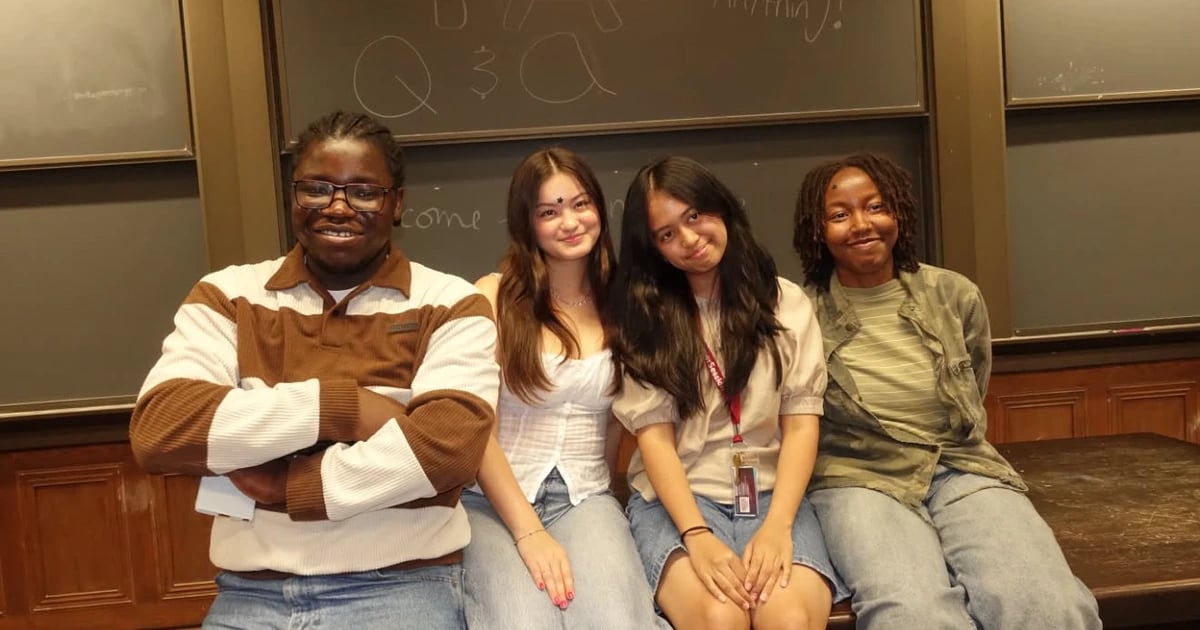
The friendships formed naturally because everyone was experiencing university life together. Even though UChicago has a reputation for being extremely serious academically, that didn't mean students didn't know how to enjoy themselves. Outside class, we explored downtown Chicago together, visited stores, wandered through the city, and simply spent time getting to know one another. Since I had previously lived in the Chicago suburbs rather than the city itself, this was also a chance for me to experience a completely different side of Chicago.
Perhaps my favourite part was how international the community was. I think during one of the larger career sessions, the speaker asked those who were from the Chicago Area to raise their hands; they made up a minority of the cohort. Students mostly came from different countries, regions, cultures, and academic interests.
Sometimes we had very little in common on paper. Yet those differences became the reason our conversations were so interesting.

A Different Kind of Academic Environment
Before arriving at UChicago, I already knew it had a reputation for academic excellence. But experiencing that culture firsthand was something entirely different. The students genuinely loved learning. They discussed ideas constantly. They read widely. They asked thoughtful questions.
They were exactly the kind of intellectually curious people you imagine when someone mentions the University of Chicago.
At first, I found that intimidating. One conversation with a teaching assistant has stayed with me ever since. At one point, he casually mentioned that he wished his SAT score had been higher. When someone asked what he had scored, he replied: 1560.
I remember thinking, "That's the score he was disappointed with?"
Part of me laughed. Another part of me suddenly understood just how competitive the environment could be. It was intimidating, but also motivating. Being surrounded by people with such high standards challenged me to raise my own expectations.
Networking That Continues Beyond the Program
One lesson connected both my UCLA and UChicago experiences.
Summer programs aren't only about classes. They're about people. At UChicago, networking happened naturally because we spent every day surrounded by professors, researchers, teaching assistants, and fellow students. We also had specific afternoon sessions dedicated to learning how to network, build your Resume, have natural conversations, and connect with professors in your field, and so much more.
Every conversation offered another perspective. Whether I wanted advice about studying biology, understanding research, navigating university life, or simply asking what students actually do outside class, there was always someone willing to share their experiences.
Those kinds of connections are incredibly difficult to build online. They're one of the greatest advantages of attending a residential summer program.

Preparing for the Visa Process
As an international student, one of the biggest logistical challenges wasn't the application itself—it was obtaining a U.S. visa.
Fortunately, I had a lot of help from my parents, who were already familiar with the process. Even so, I quickly learned that U.S. visas require extensive planning. The process can be unpredictable, and I'd heard stories from family friends who had been rejected multiple times before eventually receiving approval.
The amount of documentation required also surprised me. Alongside identification documents, I needed my birth certificate, family certificate, academic transcripts, accommodation information, and, ideally, proof that I had been accepted into a summer program.
That last requirement created a challenge because I began preparing my visa before I had received decisions from either UCLA or UChicago.
Until my admissions decisions arrived, I explained that I intended to visit universities in the United States and hoped to attend a summer academic program if admitted. Once I received my acceptance letters, I carried them with me during my trip. At immigration, when I was asked about the purpose of my visit, I explained that I was visiting universities while attending the UChicago program and showed the officer my acceptance letter.
My biggest advice is to start early, stay organised, and keep copies of every important document. Visa preparation is just as important as the application itself.
Why Summer Programs Matter
If someone asked me today whether a summer program is worth it, my answer would be immediate.
Yes.
Not because it guarantees admission. Not because it looks impressive on an application. But it gives you something you simply cannot find through rankings, brochures, or YouTube videos.
It gives you perspective. Before attending UChicago, I had certain assumptions about the university. Some were true. Others weren't. Living on campus, speaking with professors, collaborating with students, and experiencing the academic culture for myself allowed me to form opinions based on experience rather than reputation. That, to me, was the greatest value of the program.
If you're considering applying, my advice is simple: if you can financially afford it, then do it. Even if you think you've already decided where you want to study. Even if you're unsure whether the program is the right fit.
Actually living at a university (even for two weeks) can completely reshape your understanding of what you want from your future.
It certainly did for me.
For UChicago specifically, there is the added benefit of Summer Sessions opening up the ED0 option, which means you can apply in October to the university and get your decision before November 1st. If you get in great, but suppose you don’t, then you have the flexibility to EA and ED in two other rounds of early applications as well. If UChicago is your top choice, then this is something you should consider.