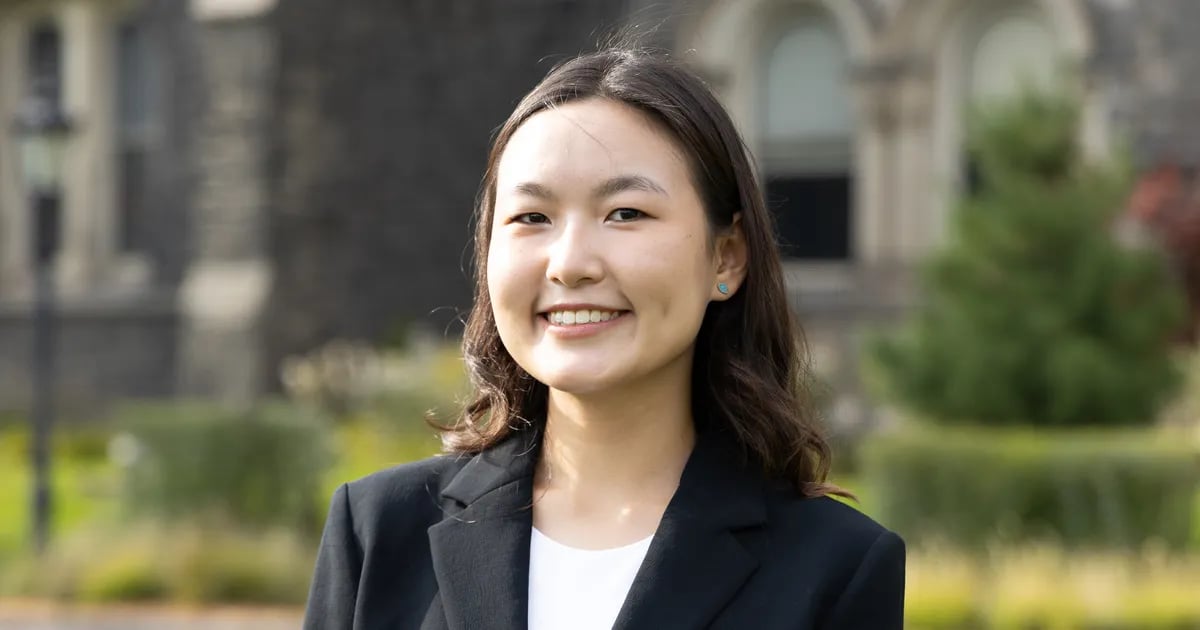
My name is Enkhjin, and I’m a student at U of T and the first Mongolian to receive a Pearson Scholarship. Since I was young, I’ve always had one goal: to help Mongolia.
I grew up in Ulaanbaatar, Mongolia, and studying abroad has always been tied to helping the 3.5 million Mongolians. Our problem isn’t the people; it’s bad leadership. So I knew I had to step up and become the kind of smart leader who could influence people, motivate people, and serve my country.
My childhood was more culturally diverse than you might expect from such a small country. I went to a Japanese-Mongolian school, spoke Mongolian at home, consumed Western media, and went to a Russian-influenced kindergarten.
Academic pressure at my school was very high. Our students were known for being high-achieving. My teachers heavily emphasized being first and being perfect, and if you weren’t, they would push you to become that person.
Our school ranked students by GPA and posted the rankings. I would walk past that board every exam cycle, see my student number, and know exactly where I stood. The top five students were constantly competing against each other.
I would wake up at 4 a.m. and sleep at 11 p.m., and I ended up becoming the valedictorian. Now that I think about it, it was a little toxic, but it definitely helped me keep my GPA high and stable at university.

Why I Had to Leave Asia
I knew I wanted to study abroad since elementary school. In Mongolia, I originally planned to go to Japan, but in middle school, I realized that I was very adaptive to my environment. Growing up in a Japanese-Mongolian-influenced culture, I felt that going to Japan might keep me in an environment where I would remain more reserved, so I wanted to push myself further out of my comfort zone.
I realized that Asia wouldn’t push me out of my comfort zone enough, so I set my sights on the UK, the US, and Canada.
The Canadian Exchange Year That Changed Everything
In my senior year, while escaping harsh academic pressure, I wanted to experience being a student in North America. I went to Canada for a three-month exchange experience. I lived in Cornwall, Ontario, so it was very different from Toronto. It was a small, predominantly white town, and I had never seen that type of culture in my life.
I was shocked by how friendly the students were with their teachers. In Mongolia, you couldn’t even ask teachers questions without being scared.
I had both great and challenging times. Regardless of how my experience went, I still applied to Canadian schools because Canada felt familiar after spending three months there.

The Great Discovery
I found out about the Lester B. Pearson Scholarship from my academic advisor during my senior year. Just two years prior, a senior with the exact same name as me had shared the opportunity with the school and connected them to the admissions officers.
I was desperate for any funding, so I decided to apply.
I looked it up: a full ride to U of T, $350,000, and 37 students selected globally out of 2,000+ applicants.
I had seen the past winners: movie and novel writers, startup founders, but I was just really involved in my community.
I honestly thought there was no way it was going to happen for me. Thirty-seven students out of 2,000+ applications? Meanwhile, I wrote my essays on time. I had written many essays at that point after my applications to the U.S. and the U.K., so I was very tired of writing essays that didn’t really showcase me. Those essays felt more like someone else’s voice added onto my experience.
I didn’t ask anybody for advice and just wrote who I truly am. The best and worst advice I got from people was, “Just be yourself in the essays,” which I had obviously overcomplicated by trying to write like someone else who had gotten into good universities before me. It ended up being very straightforward advice once I realized that it literally means what it says. Nothing puzzling.
Convincing My School Before I Convinced Myself
The internal selection process actually happened while I was on exchange in Canada. Our class had 200 students, and only one could be nominated.
The first round was a resume screening process, but at the time, mine was terrible; now that I know what a resume is supposed to look like. Somehow, I made it to the English interview stage.
They asked, “Why should we give it to you? Why are you better than everyone who got it before?”
And I started to ask myself the same question. But in the interview, I was so confident. I convinced my school that I was going to get it before I even convinced myself.

Scholarship Application Process: Essays
When I applied, I had to submit five different essays and two recommendation letters from my teachers.
One essay asked me to write a recommendation letter for myself, and another asked me to answer the question, “What if you don’t get this scholarship?”
As with many universities, there was also a “Why U of T?” essay. I researched clubs at the school and wrote about wanting to join the Women in Business Association and the Management and Economics Association, and I actually joined both clubs in my first year. To this day, I hold them fondly and am grateful for how much they helped me.
There was an essay about my dreams, and I wrote about my dream of becoming the president of Mongolia. That dream was born when I was three and eating an ice cream cake. I thought to myself, “I want Mongolia to be this ice cream world where every kid is so happy eating ice cream and no one is sad.”
I wrote about how I taught myself to be a leader even when nobody listened. At our school, the underlying issue was that students weren’t being heard. Adults would say, “We’re going to listen to you,” but they actually didn’t. So I spent hours interviewing students one by one. I talked to teachers individually about specific problems in their classrooms. I sat in meetings with principals, arguing for changes. All of this was to make the student council actually matter and to create real communication channels between students and administration.
I also wrote about the future. We have 3.5 million people in Mongolia. I think this is manageable if we just listen and actually do something about it. That’s my dream: to go back to Mongolia when I’m older and contribute to society with everything I learned at U of T.
The final essay was about my biggest challenge, and I wrote about the most embarrassing moment of my life. It was Grade 8, and I was at a panel interview for an exchange scholarship to Japan.
I was crushing it until the panel asked me some deep questions about my family, topics I had never discussed before. I answered perfectly, but the moment I stepped outside, I burst into tears in front of everyone.
My mom was mortified. Like a typical Asian parent, all she could say was, “Why would you cry outside?”
Until Grade 8, I thought I was good at everything: a top swimming competitor, someone who won every talent show, and a student with excellent grades. But that moment really made me realize that I was still not emotionally mature, and that achievements are great, but they do not entirely define me.


My Stats and Extracurriculars
My GPA was a 4.0, and I took the IELTS in Grade 11, scoring 7.5. I took the SAT in Grade 10, but my score was horrible, and since it was during COVID, I decided not to retake it. I just submitted my Mongolian transcript.
In terms of my extracurriculars, I was on the student council from Grades 9 to 12. High school actually starts in Grade 10 in Mongolia, but for some reason, they let me in despite being in Grade 9.
I built the structure from scratch, creating defined positions and writing our constitution. I also started a podcast to talk to students and create open communication channels, which was quite countercultural in both Mongolian and Japanese schools.
Furthermore, I planned all the school events: graduation, prom, and more. It all fell on the student council’s shoulders.
Throughout school, I always tried to develop my leadership. Even if I could only affect 30 people in my classroom, I strived to make a difference in that room and solve each of their problems.
I also did a lot of singing. I sang intro and outro songs for the Korean variety show Pororo when they came to Mongolia, was part of my own band, and even released a single.
I also played volleyball. It was difficult to get onto the team being 5'2", but I persevered. I had my own art exhibition as a kid and was part of the Eco and Interact Clubs. Wherever I could be involved, I was.


The DIY Application Process
I worked on the application almost entirely by myself. There were endless prep programs and services, but they cost a lot, and I didn’t want to be a burden to my family.
I told myself that even with amazing prep programs, if I didn’t work hard enough and feel passionate about it, I wouldn’t be able to reach my goal. I did hours of deep research, and I would spend day and night watching YouTube videos and reading articles on websites like College Essay Guy and Times Higher Education rankings.
Borderless was a big part of that journey, too. I would read about those students discussing their experiences and dream of being me. Some part of me wanted to prove that even without help, somebody could do it.
Finding Out on a Bus in the Middle of Nowhere
I heard back around three months after the deadline, while my entire senior cohort was on a retreat. We were on our way to a holy site to fully disconnect and pray for good luck with our futures.
At that point, I had received a lot of rejections. I started to question myself and wonder if I had overestimated my value, and if maybe studying abroad wasn’t meant for me.
We had no Wi-Fi, but we were approaching a nearby town, so I knew the signal would soon pick up. I saw an email saying there was an application update and that I needed to open the PDF, so I immediately assumed it was a rejection. I had already accepted it, telling myself I should be used to rejection by now.
The PDF wouldn’t load for 10 minutes, but then I saw, “Your tuition is covered.”
I got it. I looked at my friends and said, “I think I got the scholarship!” and started crying immediately.
But then it dawned on me: did I really become the first person to get this scholarship from Mongolia? Everything I had worked for flashed before my eyes.
At first, I didn’t understand the magnitude of it. But I realized that being the first one meant I could open the door for so many more people. Students started messaging me for advice, and I spent my free time helping them with their essays. I was so excited to help more Mongolians and others apply for the Pearson Scholarship.
My parents were thrilled. The financial relief would make a huge difference.
What the Scholarship Actually Gets You
The scholarship is worth CAD $350,000, covering tuition, books, incidental fees, and more.
If you live in residence, they cover housing costs and food. If you live off campus, they give you a set amount for rent and groceries, although not the exact amount you pay.
I’m studying abroad at King’s College London next semester, and that is all covered. It doesn’t cover daily expenses or flights home, though.
Nonetheless, there are endless additional benefits if you also work really hard for them. I was able to get TA positions, work-study jobs, and even grants for study abroad. Some of my best friends are also fellow Pearson Scholars.
If You’re Reading This, You Should Apply
One hundred percent, anyone should apply. It’s competitive, but be confident in yourself.
I came from a country that is often underrepresented in global spaces. I didn’t have experiences that looked extraordinary on paper. I didn’t do IB or AP programs. But I’m here.
The most important thing is to show your passion and who you are. Don’t use a random metaphor that has nothing to do with you. I tried and failed to use an egg metaphor. Instead, sit down and really think through your life.
I never understood when people told me to just be yourself, but you must showcase who you truly are.
Ask yourself: Are you someone who can handle U of T’s academic pressure? Will you give up after one bad mark, or do you have a bigger goal?
Let that goal drive you. You won’t regret it.