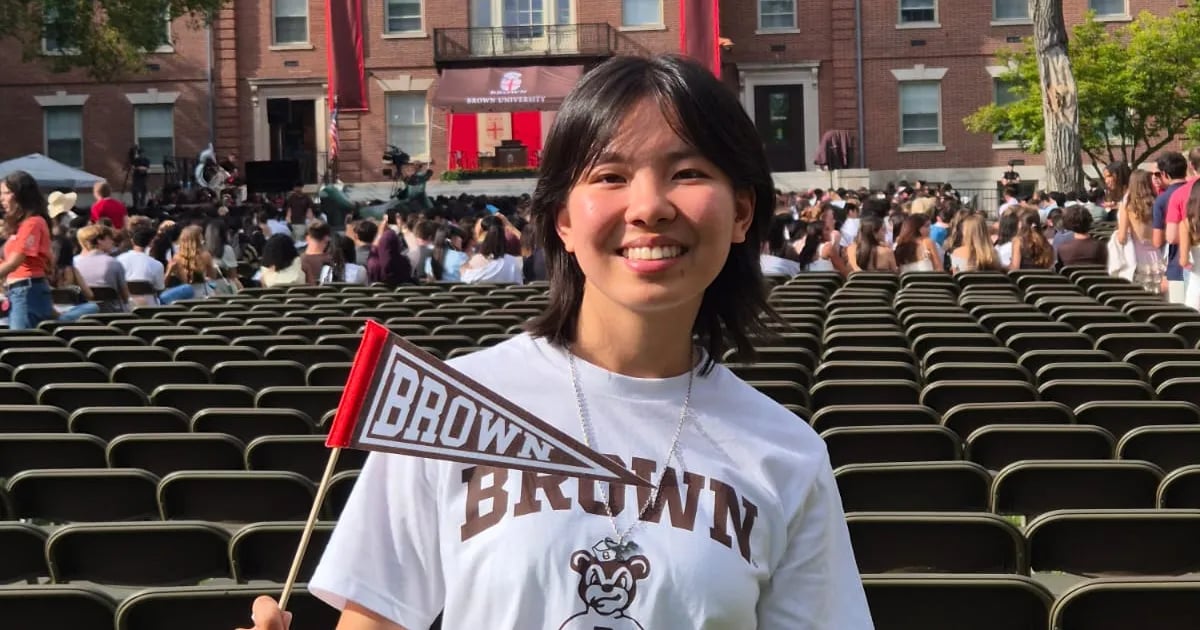

My name is Ayazhan, and I’m from Almaty, Kazakhstan. I am currently exploring Computational Neuroscience at Brown University. Here, at Brown, students declare their concentrations at the end of their sophomore year, and this flexibility has allowed me to refine my academic direction after arriving on campus.
When I first applied, I listed Psychology and Neuroscience as my intended fields of study. However, after taking courses in both disciplines, I realized I was more drawn to the mathematical and computational aspects of neuroscience rather than its purely psychological components.

Academic Profile & Standardized Testing
I graduated from high school with a 4.98 GPA. During the application process, I placed significant pressure on myself to meet certain score thresholds, particularly scoring above 1500 on the SAT and above 8.0 on IELTS.
After taking the SAT multiple times, I achieved a 1520. I also earned an 8.5 on IELTS.
At the time, these numbers felt extremely important. I compared myself to others and felt compelled to retake exams to meet competitive benchmarks. However, once admitted, I realized that students rarely discuss or compare scores. The pressure exists mostly before acceptance.
Extracurricular Development
Throughout high school, I focused on building depth across several areas rather than concentrating on a single “spike.”On my Common Application, I filled all ten activity slots. My main extracurricular categories included:
- Robotics
- Research internships and engineering collaborations
- Volunteer work and youth organizations
- Debate and independent initiatives
I began participating in clubs as early as seventh grade, eventually assuming leadership roles in high school. For example, I transitioned from participant to president within certain organizations, and I made sure to clearly demonstrate that growth in the activities section of my application.
For me, extracurricular involvement was about progress, specifically showing impact, leadership, and sustained commitment over time.


Application Strategy: Story Over Structure
One of the most important lessons I learned is that applications are not about choosing between being a “spike” student or a “well-rounded” student. What matters most is building a cohesive narrative. My academic journey involved transitioning from engineering-focused interests toward neuroscience. Instead of hiding that shift, I incorporated it into my story. Admissions officers are evaluating a person, but not whether they fall into a certain category.
The main goal of your profile should be to clearly showcase who you are, what experiences shaped you, and how your interests evolved.
That consistency across activities, essays, and academic choices, indeed, creates a strong application.
Personal Statement & Essay Approach
My personal statement focused on the power of words. It centered on a family experience involving illness and explored how language — phrases like “Everything will be okay” — can feel superficial unless they are backed by genuine presence and emotional understanding.
Rather than positioning myself as the hero of the story, I reflected on the importance of not assuming full responsibility for solving others’ struggles. Instead, I emphasized the role of igniting strength in someone else.
When mentoring other students later, I noticed a common mistake in essays: writing overly broad, cliché narratives about perseverance without highlighting a specific internal insight. A strong essay should not simply describe hardship. It should focus on a particular value, realization, or personal perspective that defines you.


Why Brown University?
I applied to nearly 30 U.S. universities. I was waitlisted at eight and rejected by most of the others. Brown was the final decision I received and the only U.S. university that offered me a financial aid package I could realistically afford.
What drew me to Brown was its open curriculum. There are no required core classes, which allows students to design their own academic paths. At a time when students are expected to have their futures completely mapped out, Brown creates space for exploration.
In my first semester, I took a variety of courses, including linguistics and developmental psychology. That academic freedom allowed me to test my assumptions about my interests. It was through that process that I realized my passion lay in computational neuroscience rather than psychology.
Brown’s collaborative environment also stood out to me. Students come from diverse academic backgrounds, and there is no strong culture of competition. Classrooms often include individuals concentrating in entirely different disciplines, which creates a genuinely interdisciplinary atmosphere.
Financial Aid as an International Student
As an international student, financial considerations were central to my decision. Brown meets demonstrated financial need, but international students must reapply for financial aid each year.
After submitting the CSS Profile, I received need-based support that made attending Brown possible. Each year, students must resubmit financial documentation so the university can reassess their circumstances and adjust aid if necessary.
For international applicants, understanding these financial policies early and planning their academic journey accordingly is essential.
Campus Life & Academic Adjustment
Adjusting here socially required adaptation, and some time. In Kazakhstan, casual small talk with strangers is less common. On the contrary, at Brown, spontaneous interaction and openness are part of the culture.
During my first semester, I primarily stayed within my close circle of friends. In my second semester, I became more intentional about engaging with the broader community by attending events, joining activities, and stepping outside my comfort zone.
Academically, I am currently taking mathematics, computer science, and computational neuroscience courses. They are rigorous and technically demanding, but deeply stimulating. Professors are approachable, and building relationships with faculty makes the academic experience more personal and engaging.
Balancing academics and social life remains challenging. Creating structured goal tables and defining priorities across different areas of my life has helped me manage that balance more intentionally.
Advice for Applicants
If I had to offer one piece of advice, it would be: be quirky.
By that, I mean stay genuinely connected to yourself. Your interests will evolve. Your self-perception will shift. But the most powerful application emerges when you communicate an authentic version of who you are at this stage of your life.
To turn my perspective into practical advice:
- Stay true to your current intellectual interests, even if they are still evolving
- Focus on building a coherent story rather than fitting into a category
- Show progression and leadership within your activities, not just participation
- Compare less, reflect more
- If needed, seek help for essay writing since strong storytelling matters
- Understand that rejection does not define your capability or potential
The U.S. application process can feel overwhelming, especially for international students navigating financial aid and competitive admissions. However, when you approach it with clarity and self-awareness, it becomes more about direction and building a path that genuinely aligns with who you are becoming.