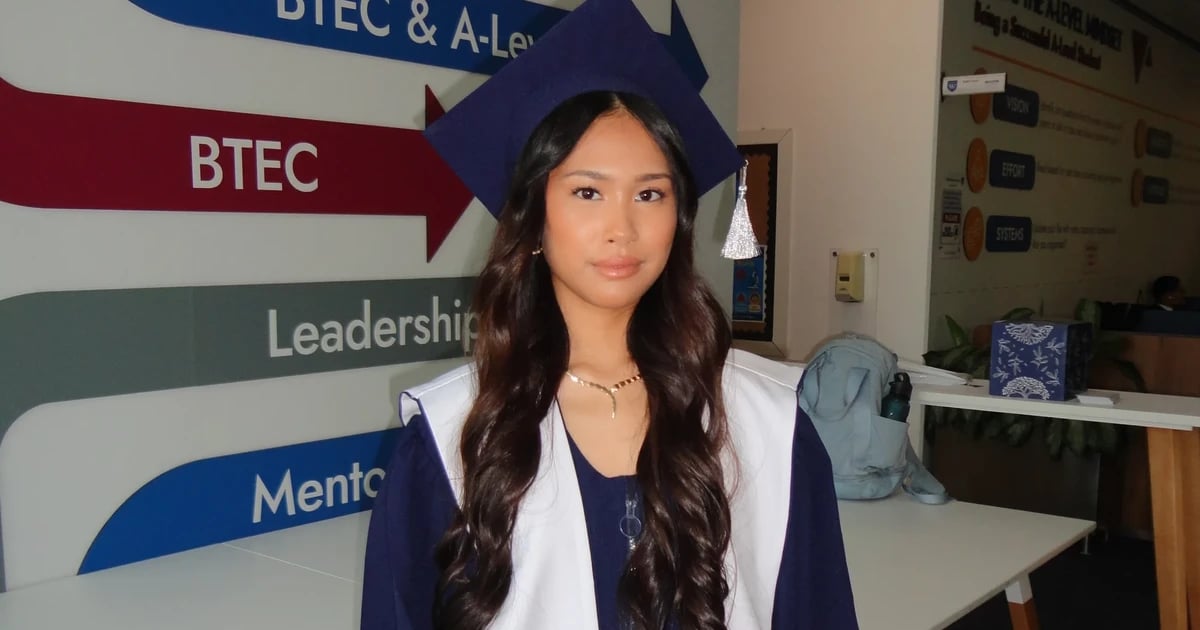

Hey! I’m Florence Argana, a Filipino student born and raised in Qatar. For most of my life, I studied at Philippine School Doha (PSD), where I completed my education through junior high school. After Grade 10, I transferred to GEMS Wellington School-Qatar to complete the rest of my secondary education.
My journey followed a less common pathway for Filipino students in Qatar, and I’m glad I took that step. Today, I’m studying Economics at the University of Bath in the United Kingdom.
The Cost of Staying the Same
For most of my life, I studied under the Philippine curriculum at PSD. By Grade 10, however, I already knew that I didn't want to continue with the same curriculum for Senior High School.
My sister played a significant role in helping me discover another path. She had also left PSD after Grade 10, transferred to an international school, and completed the International Baccalaureate (IB). Watching her experience a different educational environment and seeing how she grew and flourished influenced my own decision.
Philippine schools often have large student populations, and I felt that there was less individual attention given to university preparation. Seeing my sister's experience helped me realize that an international curriculum could offer me more focused support and better prepare me to compete for places at universities abroad.
I'm also the kind of student who needs time to adjust to a new environment. Once I find my footing, though, I'm able to work hard and prioritize my goals.
Initially, transitioning from a Philippine school to an international school was challenging because the curricula were so different. However, Wellington made the adjustment easier. The school had a smaller student cohort, more teachers and staff available to support us, and greater opportunities for one-on-one guidance. Having access to those resources made a significant difference, especially when preparing for university applications.
Leaving a familiar environment doesn't necessarily mean leaving everything behind. Sometimes, you have to take a step into the unfamiliar to find an environment that better aligns with your long-term goals.

The Application Economy
At first, the application process felt overwhelming. There were strict deadlines, and preparation had to begin well before my final year of school.
After settling into Wellington, I focused on participating in extracurricular activities, volunteering, and pursuing other experiences that could strengthen my university applications.
By Year 13, I began working on the applications themselves.
The UCAS Application itself was relatively straightforward. Students can apply to up to five university courses through a single application, which requires a personal statement and a teacher reference, among other details. The application deadline for many undergraduate courses falls in January, although some courses have earlier deadlines.
Additionally, I procrastinated a little. I initially planned to finish my personal statement around September or October, but I ended up submitting my application in November.
Eventually, the process became less stressful once I established a routine. Working on my personal statement consistently, seeking feedback from tutors and mentors, and reviewing my work helped make everything more manageable.
Counting Numbers
Students following the British curriculum typically complete GCSEs or IGCSEs before progressing to A-Levels. However, because I came from the Philippine curriculum, I hadn't taken either qualification before applying to Wellington.
Instead, I was asked to take a placement test that assessed my cognitive and reasoning abilities. Thankfully, I performed well, which contributed to my acceptance into Wellington.
When it came to university applications, I didn't consider SAT scores particularly important for my UK applications. Although I took the SAT, I didn't submit my scores through UCAS, as my applications primarily focused on my A-Level qualifications.
I took Business, Economics, and Mathematics A-Levels and also completed an Extended Project Qualification (EPQ). These subjects allowed me to explore my academic interests, particularly Economics, while preparing for the degree I wanted to pursue at university.
Investing Beyond the Classroom
Outside the classroom, I participated in several extracurricular activities at Wellington. One of my main commitments was Model United Nations, where I was fortunate enough to become President of the General Assembly during my first year. I continued in that role through my senior year.
I also became head of the prom committee, leading a team of five students in organizing a large-scale event for the sixth-form cohort.
Another opportunity I took part in was Be the Change, a year-long program focused on service, volunteering, and community engagement. As part of the program, we completed online courses and worked on a project to earn our certification. We also volunteered for an hour each week throughout the year, and I worked as a teaching assistant for primary school students.
While these extracurricular experiences helped me develop my leadership and interpersonal skills, I focused more heavily on supercurricular activities when demonstrating my academic interests in my university applications.
One particularly valuable experience was a two-week internship at Commercial Bank during the summer before my senior year.
During the internship, we learned about the bank's services, including credit cards, loans, account opening procedures, and mobile banking. We were paired with customer service representatives and shadowed them to understand their daily responsibilities, how the bank operated, and how they interacted with customers.
Although the internship was relatively short, it gave me an opportunity to observe how financial services worked in practice. Alongside my EPQ, which explored topics related to Economics, the experience became an important part of my application and helped demonstrate my interest in the field.
Five for Five
Through UCAS, I applied to five UK universities: namely,the University of Bath, the University of Bristol, the University of Manchester, the University of Leeds, and the University of Kent. Fortunately, I received offers from all five.
After considering my options, I selected the University of Bath as my firm choice and the University of Manchester as my insurance choice.
One of my main priorities when choosing a university was finding a course that offered a placement year. A standard undergraduate degree in the UK typically takes three years, while a degree with a placement year usually takes four. The placement year allows students to gain practical work experience, often in an industry related to their degree, before completing their studies.
For someone interested in finance, the opportunity to gain professional experience before graduating was particularly appealing.
The University of Bath stood out because of its emphasis on placement opportunities. Its support systems, including tutors and mentors who can guide students in finding placements, were also important factors in my decision. The university's connections with companies and firms offered another opportunity to explore the professional world while studying.
The Other Side of the Exchange
I've only been at the University of Bath for around three to four weeks, but I've already noticed several differences between university life in the UK and life in Qatar.
Qatar feels much quieter and more peaceful in comparison. There's a certain stillness to being able to walk outside at night, whereas the UK has a more prominent culture of nightlife, university societies, and going out with friends.
I haven't found the transition particularly difficult so far. For now, I'm simply adjusting to a new environment and getting to know a different group of people.
One noticeable difference is the demographic makeup. The UK university environment I've experienced so far is predominantly white, whereas Qatar has a much wider mix of nationalities and ethnic backgrounds. It's been interesting to experience a different social environment after growing up in such a diverse community.
My weekly timetable is fairly structured, which has helped me establish a routine. Since I live on campus, I usually wake up around 30 minutes to an hour before class, get ready, have breakfast, and walk to my lectures.
Some days are packed with classes, while others might involve only one lecture. During my free time, I'll grab something to eat or catch up on coursework before heading to my next class. Outside academics, there are plenty of opportunities to socialize, whether through university events or going to pubs and clubs with friends.
University life has given me a different kind of independence, one that I'm discovering how to make the most of.
The Social Equation
One thing that surprised me about university life was how open people seemed to be toward making friends. People have generally been welcoming, and there's a culture of striking up conversations with those around you, even if you've never met them before.
Although this isn't entirely unfamiliar to me, I've noticed that it's more common here to start conversations with strangers and actively meet new people.
At the same time, I've become aware of social divides between different groups. Students sometimes gravitate toward people of similar backgrounds or racial identities. While this may not always be intentional, it's something you begin to notice as an international student navigating an unfamiliar environment.
Thankfully, university also offers opportunities to find people with whom you share common experiences. Bath has a wide range of societies, including a Filipino society. I haven't attended one of its events yet, but I've already befriended a couple of Filipinos, as well as other Asian students.
Having people around me who share similar backgrounds or experiences gives me something familiar to connect with. It reminds me of my roots and what it means to be Filipino, even while living far from home.
I'm still in the early stages of university life, so I'm learning as I go. I don't think anyone can immediately adapt to every aspect of a new environment. Finding your place takes time, and I think being open to new experiences makes that process easier.
The Bottom Line
As cliché as it sounds, if I could tell my high school self one thing, it would be that everything was going to be fine. I wish I had known that university wasn't going to be as terrifying as I'd imagined.
Planning the next crucial years of your life can feel intimidating, especially when it seems like every decision will determine your future. Looking back, though, the application process wasn't as overwhelming as I had made it out to be. As long as I put in the effort, met my deadlines, and sought help when I needed it, things became much more manageable.
Change can be overwhelming, especially when it means leaving behind an environment you've known for most of your life. But if you want to grow, sometimes you have to take that first step toward something different.
Had I stayed within the familiarity of the Philippine curriculum, I might not have pursued the same opportunities to study abroad. Applying to universities overseas would likely have been a more challenging process for me.
Sometimes, you have to do your part, take the leap, and give yourself the chance to see where it leads.
If you're done with your part, let things fall into place for you.